

When a yeast infection returns again and again, the usual reason is not poor hygiene. More often, the diagnosis was never confirmed, the course of treatment was too short for a recurring pattern, a different yeast species is involved, or something in your health (antibiotics, blood sugar, hormones) keeps tipping the balance. Recurrent infections are treatable, but they need a proper exam and, often, a lab test rather than another round of guesswork. At Macie Medical in Katy, same-day sick visits and women’s health care are available so you can get that exam without waiting weeks.
TL;DR
- Three or more symptomatic yeast infections in less than a year count as recurrent, according to the CDC’s STI Treatment Guidelines.
- Other conditions can feel identical to a yeast infection, so confirming the diagnosis comes first.
- Common triggers include recent antibiotics, diabetes, pregnancy, hormonal changes and a weakened immune system.
- Recurrent infections are usually treated with a longer starting course followed by weekly maintenance medication prescribed by a clinician.
- Probiotics and yogurt are not a replacement for treatment, and new prescription options exist for some patients.
Table of Contents
- What counts as a recurring yeast infection
- Is it really a yeast infection?
- Why yeast infections keep coming back
- How a clinician confirms the diagnosis
- How recurrent yeast infections are treated
- What about yogurt and probiotics?
- Everyday habits that support prevention
- Our perspective
- Getting care in Katy
- FAQ
- Sources
What counts as a recurring yeast infection
A vaginal yeast infection (vulvovaginal candidiasis) happens when Candida, a fungus that normally lives in the vagina in small numbers, overgrows. ACOG explains that this can happen when the usual balance of bacteria and yeast shifts.
One infection that clears and returns once is common. Medicine draws a line at a pattern: the CDC defines recurrent vulvovaginal candidiasis as three or more symptomatic episodes in less than a year, and says it affects fewer than 5% of women (CDC STI Treatment Guidelines, 2021). The International Society for the Study of Vulvovaginal Diseases uses a similar definition, with the episodes confirmed by culture (ISSVD).
If you have had two infections in a year and a third seems to be starting, that is already a good reason to be seen. If it feels like the same infection never fully leaves, that is worth describing to your clinician too.
Is it really a yeast infection?
This is the first question to settle, and it is the one most often skipped. Itching, burning, redness and discharge are not unique to yeast. ACOG notes that even if you have had a yeast infection before, you may think you have one when you actually have another problem, and treating the wrong condition delays the right diagnosis.
Classic yeast infection signs, as the CDC describes them, include vulvar itching, pain, swelling and redness, burning when urine touches the outside skin, and a thick, curdy discharge. Things that can be mistaken for it include bacterial vaginosis, other infections and skin irritation from products or fabrics.
Here are signs that point toward getting seen rather than treating at home again:
- Your symptoms are new or different from your last infection.
- Over-the-counter treatment did not fully clear things up.
- Symptoms return within weeks of finishing treatment.
- You have diabetes, are pregnant or have a condition that affects your immune system.
- You also have fever, pelvic pain or unusual bleeding.
ACOG says over-the-counter yeast treatments are safe and often effective but can mask another problem, and it advises a visit if this is your first time with symptoms or if the medication does not resolve them.
If you want a hand with everyday habits while you sort out the medical side, this guide to period underwear and yeast risk covers fabric and moisture choices that matter for some women.

Why yeast infections keep coming back
There is rarely a single cause. These are the factors clinicians look for.
Antibiotics
Antibiotics treat bacteria, but they can also reduce the helpful bacteria that keep yeast in check. The CDC lists current or recent antibiotic use as a risk factor for vaginal candidiasis. If your infections follow every course of antibiotics, tell your clinician, because that pattern changes how prevention is planned.
Diabetes and blood sugar
Diabetes is on the CDC’s risk factor list, and the CDC guidelines name it as one cause of recurrent infection. Blood sugar that runs high gives yeast more to feed on. If you have never been screened, recurrent yeast infections are a reasonable reason to ask for a glucose check. Ongoing diabetes care is part of the primary care we provide, so the vaginal symptoms and the underlying condition can be handled by the same clinician.
Hormones, pregnancy and contraception
The CDC names pregnancy and hormonal contraceptive use among the risk factors, and ACOG points to hormone changes in pregnancy. If your infections began after starting or switching a method of birth control, or during perimenopause, mention the timeline. Hormonal shifts are something we address in women’s health and menopause care.
A weakened immune system
ACOG notes that in people with immune-system conditions such as HIV, yeast infections may be severe, may not go away with treatment, or may recur often.
Moisture and clothing
The Merck Manual says keeping the vulva dry and wearing loose, absorbent cotton clothing can reduce the moisture that encourages yeast growth. Changing out of damp workout clothes or swimsuits promptly is a simple habit that fits a Houston-area summer.

Sometimes there is no clear cause
The CDC is candid that how recurrent infection develops is poorly understood, and that most women with it have no obvious underlying condition. If your checks come back normal, that does not mean your symptoms are imagined. It means the plan focuses on treatment and prevention rather than a single fix.
A different species of yeast
Most recurrent infections, roughly 85% to 95%, are caused by Candida albicans, according to a 2023 review in PLOS Pathogens. The rest involve other species. The CDC says Candida glabrata and other non-albicans species turn up in 10% to 20% of women with recurrent infection, and that standard antifungal treatments are not as effective against them. A treatment that works well for one species can fall short for another, which is one reason confirming the species matters.
How a clinician confirms the diagnosis
A proper workup for recurrent symptoms usually has three parts: your history, an exam, and a lab test on a sample of vaginal discharge.
- History. Your clinician asks how often symptoms occur, what you used to treat them, recent antibiotics, your health conditions and your medications.
- Exam. Swelling, redness, small skin tears and discharge appearance all give clues.
- Laboratory testing. The CDC says the diagnosis is confirmed when a microscope exam of discharge shows yeast forms, or when a culture is positive. Culture remains the reference standard. The PLOS Pathogens review notes culture can take 48 to 72 hours.
The ISSVD recommends yeast cultures when a patient presents with recurrent candidiasis or when symptoms are not explained by the microscope exam. A 2022 review in PMC also says women with recurrent infection are more likely to have less common species or azole-resistant strains, so confirmatory microscopy and fungal culture belong in the clinical workup.
Because the right lab result guides the right prescription, it helps when your doctor’s office and on-site lab services are connected. You can read about our approach to vaginal yeast infection treatment in Katy and other vaginal infections.
How recurrent yeast infections are treated
Treatment for recurrent infection differs from treatment for a one-off. The usual pattern has two phases. Doses below come from the guidelines and are prescribed and adjusted by your clinician. Do not use them as a self-treatment plan.
Phase 1: a longer starting course
The CDC recommends 7 to 14 days of topical therapy, or oral fluconazole 100, 150 or 200 mg every third day for three doses (days 1, 4 and 7), to try to bring the infection fully under control before maintenance begins. The ASCCP’s patient resource describes the same idea: for frequent infections, a longer course may be needed.
Phase 2: maintenance to prevent relapse
Once symptoms are controlled, guidelines call for a weekly preventive medicine. The 2022 PMC review describes fluconazole 150 mg weekly for up to 6 months, or weekly or twice-weekly topical clotrimazole, as accepted regimens. It reports that symptoms are controlled in about 90% of women who complete at least 6 months, but that infection can return in up to 50% after treatment stops, because maintenance suppresses yeast rather than eradicating it.
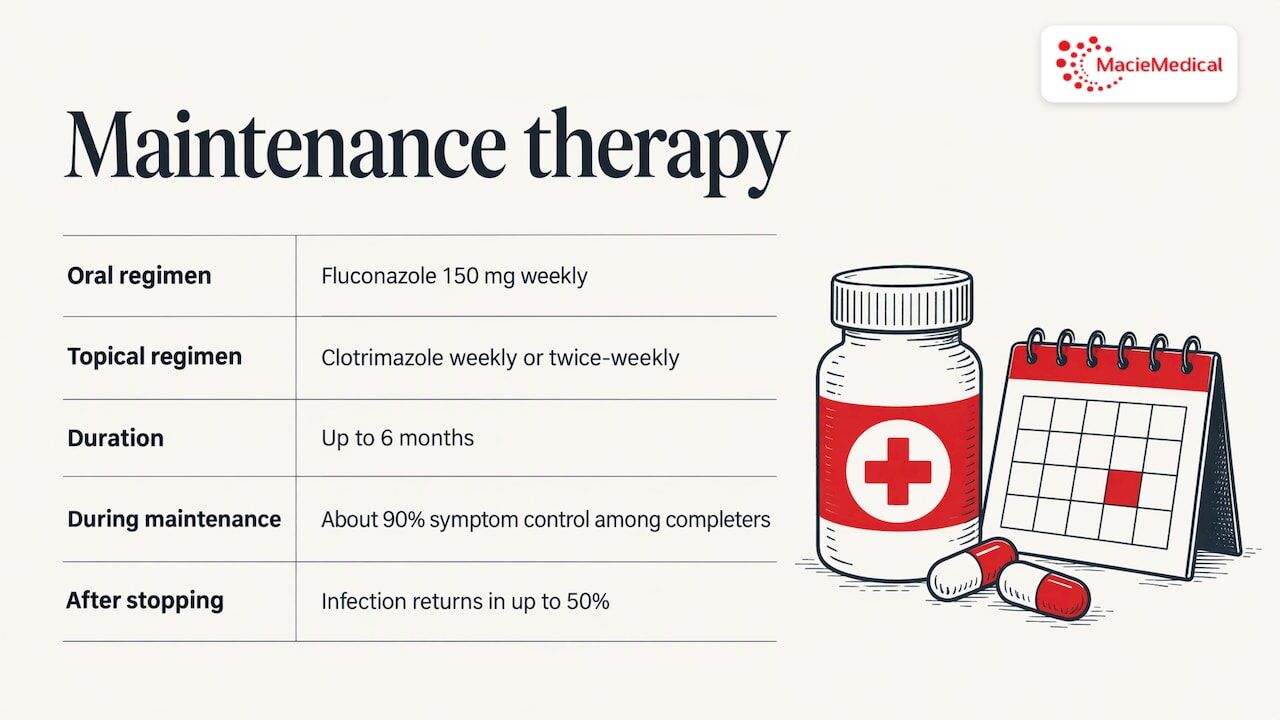
That last point is useful for planning. If infections return after maintenance ends, it does not mean you did something wrong. It means a follow-up conversation about the next step. The CDC advises women with persistent or recurrent symptoms to return for follow-up.
Other prescription options
The CDC’s treatment page says that if symptoms return, do not improve or worsen, providers may prescribe more fluconazole doses or other vaginal medicines such as boric acid, nystatin or flucytosine.
Newer oral antifungals also exist. A 2026 review in Frontiers in Microbiology reports that ibrexafungerp (Brexafemme) was approved by the FDA in December 2022 to reduce recurrent infection, and oteseconazole (Vivjoa) was approved in April 2022 for recurrent infection in women who cannot become pregnant. The Merck Manual notes oteseconazole should not be used by women who can become pregnant because of a risk of birth defects. The review also says the CDC’s core recommendation of induction followed by maintenance therapy remains the standard approach.
Safe-use points
- Take your medication exactly as directed, even if symptoms fade early. ACOG warns that stopping early may let symptoms return.
- Tell your clinician if you are pregnant or could become pregnant before any antifungal is chosen.
- The Merck Manual notes that vaginal antifungal oils can weaken latex condoms and diaphragms during treatment, so ask about backup protection.
- Itching and irritation can linger for a short time after the infection itself is gone, according to the ASCCP resource. Persistent symptoms beyond that deserve a call.
What about yogurt and probiotics?
The evidence is mixed. A 2024 review in PMC found a generally positive but inconsistent picture of probiotics for vulvovaginal candidosis. Fluconazole remained more effective than probiotics for treatment, while combining the two appeared to reduce recurrence and improve symptoms. The reviewers noted that products, populations and regimens vary too much for clear conclusions.
The practical takeaway: probiotics are something to discuss as an add-on to a treatment plan, not a stand-in for one. Eating yogurt as part of a balanced diet is fine, but it is not a proven way to stop infections that keep returning.
Everyday habits that support prevention
None of these replace medical treatment, but together they make your plan easier to maintain:
- Wear breathable cotton underwear and change out of wet clothing quickly.
- Keep the vulvar area dry and avoid scented soaps, sprays and douches that irritate sensitive skin.
- Tell every clinician about each antibiotic course so prevention can be planned around it.
- Keep blood sugar in your target range if you have diabetes.
- Keep a short symptom diary: dates, what you took, what you ate or did beforehand and whether you had recent antibiotics. Patterns often show up within a few months.
If you also deal with urinary symptoms, our guide to recurrent UTIs in women explains how those differ from yeast infections, since the two are easy to confuse. For a broader look at routine screenings, see our women’s health checklist.
Our perspective
Recurring yeast infections wear people down. They interrupt sleep, relationships and work, and many patients tell themselves they should have this figured out by now. You should not have to figure it out alone.
At Macie Medical, we believe the most useful thing we can offer is time. Dr. Judith Aniekwena is board-certified in internal medicine, which means she looks at the whole person: blood sugar, medications, hormones, weight and the other conditions that can sit behind a pattern like this.
We offer same-day sick visits, so you do not have to wait through another week of symptoms, and telehealth appointments for patients anywhere in Texas, which can make follow-up easier to fit into your life. Our goal is that you leave understanding your plan, including what to expect from treatment and when to come back.
If your infections are tied to a larger health picture, such as diabetes, menopause or weight, we can address those in the same relationship rather than sending you from one office to another.
Macie Medical
Getting care in Katy
Macie Medical is a primary care practice serving Katy, Cypress, Richmond and Memorial City, with women’s health care, same-day sick visits, chronic condition management and on-site lab services under one roof. Since November 16, 2026, we have welcomed patients at our larger office at 633 E Fernhurst Dr, Suite 205, Katy, TX 77450.

If you are paying out of pocket, our cash pay clinic page explains how that works. You can also see everything we offer on our services page. Call or book online to schedule your visit.
FAQ
Can a yeast infection go away and come back?
Yes. Symptoms can clear and return, especially if treatment was shorter than needed, if a risk factor such as antibiotics or high blood sugar is still present, or if the original problem was not a yeast infection. Three or more episodes in a year is considered recurrent and calls for a medical workup.
How do I stop recurring yeast infections?
The usual route is to confirm the diagnosis with a lab test, treat with a longer initial course, then use weekly maintenance medication prescribed by a clinician, often for about six months. Addressing triggers like antibiotics, blood sugar and moisture helps too.
What gets mistaken for a yeast infection?
Bacterial vaginosis, other vaginal infections and skin irritation from products or fabrics can all cause itching, burning and discharge. ACOG notes that treating the wrong condition delays proper diagnosis, so symptoms that feel different from before are worth an exam.
Is yogurt good for yeast infections?
The research on probiotics is mixed. A 2024 review found they may help reduce recurrence when combined with antifungal treatment, but fluconazole worked better than probiotics alone. Yogurt can be part of your diet, but it should not replace a prescribed plan.
Sources
- Vulvovaginal Candidiasis, CDC STI Treatment Guidelines (2021)
- Risk Factors for Candidiasis, CDC
- Treatment of Candidiasis, CDC
- Vaginitis, ACOG
- Vulvovaginal Candidiasis, ISSVD
- Insights and advances in recurrent vulvovaginal candidiasis, PLOS Pathogens (2023)
- Clinical challenges in diagnosis and treatment of recurrent vulvovaginal candidiasis, PMC (2022)
- Yeast Infection patient resource, ASCCP (2024)
- Advances in vulvovaginal candidiasis research, Frontiers in Microbiology (2026)
- Vaginal Yeast Infection (Candidiasis), Merck Manual Consumer Version
- Probiotics in the Management of Vulvovaginal Candidosis, PMC (2024)
- Period underwear and yeast infection risk