
A primary care referral is your doctor’s formal order to see a specialist or receive a certain medical service, and whether you need one depends mostly on your health plan. The smoothest path is to have a primary care physician who knows your history, understands your plan, and walks you through each step before you leave the exam room. That is the kind of long-term partnership we build with adults in Katy, Cypress, Richmond, and Memorial City, so a referral feels like a clear next step and not a puzzle.
TL;DR
- A referral is an order from your primary care provider to see a specialist or get a service. Prior authorization is a separate approval from your health plan, and you may need one, both, or neither.
- Your plan’s rules decide what is required. Your insurance card’s member-services number and your plan documents give the definitive answer.
- Ask before you book: does the specialist need a referral, does the service need prior authorization, and is the specialist in your network?
- Decisions are not instant. Timelines vary by plan, so build in time, and for urgent problems tell your doctor’s office it is urgent.
- In an emergency, go to emergency care. Do not wait for paperwork.
Table of Contents
- What a referral actually is
- Referral versus prior authorization
- Do you need a referral? It depends on your plan
- How the referral process works, step by step
- How long does a referral take?
- When your primary care doctor may refer you
- If you need care urgently
- Common snags and how to handle them
- A short checklist before any specialist visit
- Our perspective: a referral works best inside a relationship
- Make your next step a manageable one
- FAQ
- Sources
What a referral actually is
When your primary care doctor decides you need care beyond what they can provide, they send you to someone with the right training: a cardiologist, a dermatologist, an orthopedic surgeon, a physical therapist, or a imaging center. The National Association of Insurance Commissioners (NAIC) describes a referral as an order from a primary care provider to see a specialist or receive certain medical services.
The referral is more than a permission slip. It usually carries your medical history, current medications, test results, and the reason you are being sent, so the specialist does not start from zero. That handoff is one reason having one primary care home matters. A doctor who has seen your blood pressure readings, your lab trends, and your family history writes a much more useful referral than a provider who is meeting you for the first time. If you want to understand that bigger picture, our guide on why you need a primary care physician explains it in more depth.
Referral versus prior authorization
These two terms get mixed up, and the difference can affect your bill.
- Referral: your primary care provider’s order to see a specialist or get a service.
- Prior authorization: approval from your health plan before a service or prescription is covered.
Per the NAIC, depending on your plan’s rules, one or both may be required. The NAIC also says a plan may refuse to pay when a required referral or authorization was not obtained. Regulators in other states say the same thing in their own words: the California Department of Managed Health Care explains that a referral and prior approval are distinct requirements that may both apply.
In practical terms, a referral alone does not always guarantee that a service will be approved. New York’s Medicaid managed-care member handbook notes that some treatments and services need plan approval in addition to a referral. Imaging such as an MRI, a surgery, or an expensive medication are common examples of services where a plan may want to review the request first.
Do you need a referral? It depends on your plan
There is no single national rule. Your plan type is the biggest factor, and it is worth knowing which one you have.
| Plan type | Typical referral approach | What to do |
|---|---|---|
| HMO | Often asks you to choose a primary care provider and to get a referral before seeing a specialist | Confirm the specialist is in the plan’s network and that the referral is on file before the visit |
| PPO | Often lets you book a specialist directly, usually with different costs in and out of network | Check network status and any prior authorization for the service |
| Medicare Advantage | Rules vary by plan | Read your plan documents or call member services |
| Self-pay (no insurance) | No insurer referral rules apply | Ask the specialist’s office what they require and what they charge |
Treat that table as a general pattern, not a promise about your plan. Rules differ from one insurer and one state to the next. The California regulator says referrals and prior approval may be required for specialist visits, procedures, special tests, surgery, non-emergency hospital admission, second opinions, and out-of-network doctors under the plans it regulates. It advises patients to check their Evidence of Coverage, which is the document describing what your plan covers, or to call the member-services number on the insurance card.
If you are comparing plans or you are a senior sorting out coverage choices, this overview of HMO and PPO plan differences shows how plan structure affects referrals, coverage, and what you pay. Our article on health insurance literacy also helps with the vocabulary you will see on your card and your explanation of benefits.

How the referral process works, step by step
Here is the routine most patients follow. The details change by plan, but the order rarely does.
- Talk with your primary care doctor. Describe your symptoms, what you have already tried, and how they affect your daily life. The doctor decides whether a specialist is the right next step and which kind. At your visit, ask what the specialist is expected to answer for you.
- Ask what your plan requires. Ask the office whether the specialist visit needs a referral, whether the test or procedure needs prior authorization, and whether the specialist is in network. The NAIC notes that patients can ask their provider whether prior authorization is required, and that some providers contact the health plan directly to obtain it.
- Choose the specialist. If your plan has a network, pick from it. Ask your doctor whom they would send a family member to, and check the specialist’s availability, because wait times vary a great deal.
- Confirm the referral was sent. Before you book, make sure the referral and your records actually reached the specialist’s office. A quick call saves a rescheduled visit.
- Watch for the decision. If your plan reviews the request, a decision may come by letter, portal message, or phone. One Medi-Cal plan, for example, says members get a decision letter identifying the approved specialist or test and should then call the specialist or testing facility to arrange the appointment.
- Book and bring your list. Bring your medication list, insurance card, photo ID, and any questions you wrote down.
- Close the loop. After the visit, ask the specialist to send their notes back to your primary care doctor, and schedule a follow-up with your primary care doctor to talk through the findings.
The last step is where having one trusted doctor pays off. The specialist treats the problem in front of them, while your primary care physician keeps the whole picture: your other conditions, your medications, and your goals.
How long does a referral take?
There is no nationwide clock, and you should be wary of any single number. Examples show the range:
- The California regulator says that, for plans under its oversight, a medical group or plan usually must grant or deny prior approval within three to five days, and urgent appointments for services requiring prior approval should be schedulable within 96 hours.
- One Medi-Cal plan says its referral review decision is made within five business days, or within 72 business hours when the doctor marks the request urgent. That is that plan’s timeline, not a rule for every plan.
The lesson for Texas patients is simple: ask your plan how long its review takes, and ask your doctor’s office to mark a request urgent when your symptoms call for it. Then add the specialist’s own scheduling wait, which can be longer than the approval itself.
When your primary care doctor may refer you
Primary care covers a wide range of problems. Many chronic conditions can be managed in your doctor’s office, and our guide on whether primary care doctors can treat diabetes shows how much is handled without leaving the practice. Blood pressure, thyroid disorders, and weight concerns are other examples of ongoing care a primary care physician can manage.
A referral comes into play when the question needs deeper expertise or equipment. The American Academy of Pain Medicine, writing for primary care clinicians about chronic pain, says the decision depends on the clinician’s expertise and specialist availability. It lists situations where referral can be considered: pain with no clear cause, treatment that is not helping, impaired function, or a clinician who is uncomfortable continuing care. Those same ideas apply well beyond pain. If something is not improving, is getting in the way of work or family life, or has no clear explanation, that is a good moment to ask, “Is it time for a specialist?”
A good referral conversation sounds like this: your doctor explains why they are recommending it, what the specialist is likely to do, and what you should expect next. If that does not happen, ask.
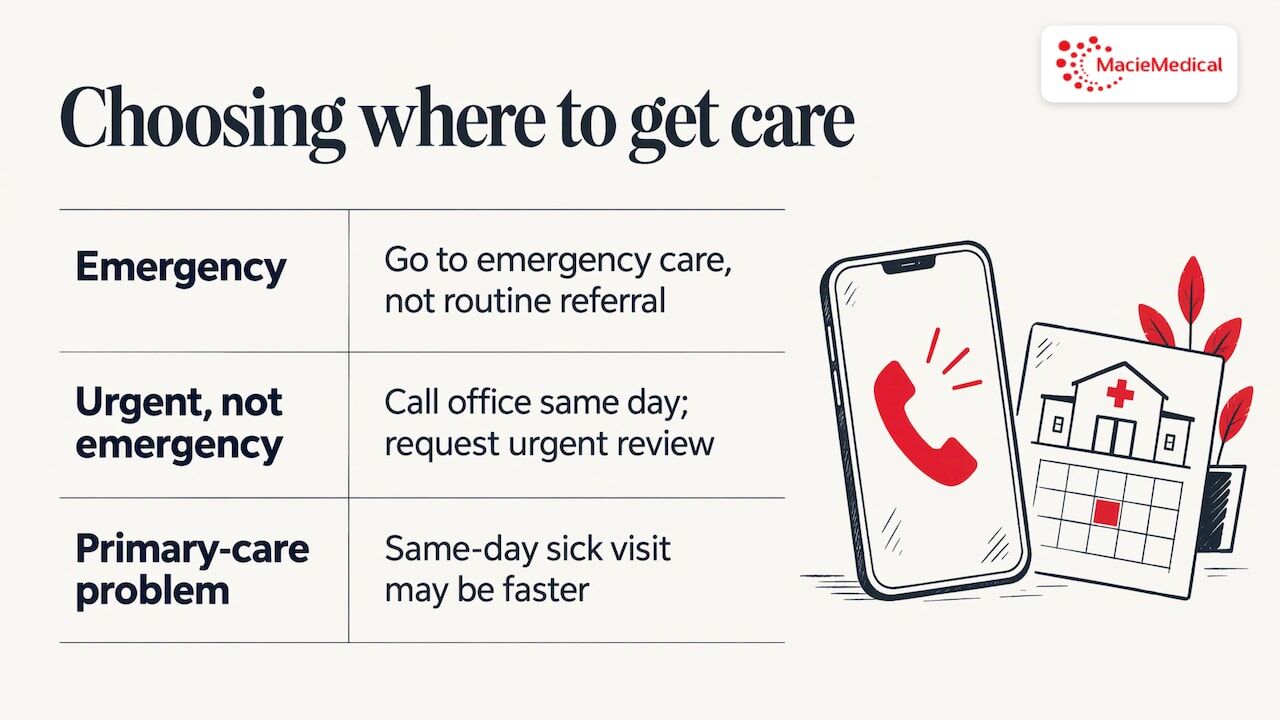
If you need care urgently
If it is an emergency, go to emergency care instead of waiting on a routine referral. As one example, a Colorado HMO network access document states that members do not need to contact a primary care physician or get preauthorization before emergency care. That document applies to that plan only, but the principle is widely shared: emergencies come first, and paperwork comes after. Call 911 for chest pain, trouble breathing, signs of a stroke, severe bleeding, or any situation you believe is life threatening.
For urgent problems that are not emergencies, such as a worsening condition that cannot wait weeks, call your primary care office the same day. Explain what changed, ask whether the request can be marked urgent, and ask your plan about expedited review. Timelines differ by plan and by state.
When the problem is something your primary care doctor can handle directly, a same-day sick visit may be faster than any referral. Our practice offers same-day sick visits for exactly that reason, and telehealth appointments are available for patients anywhere in Texas.
Common snags and how to handle them
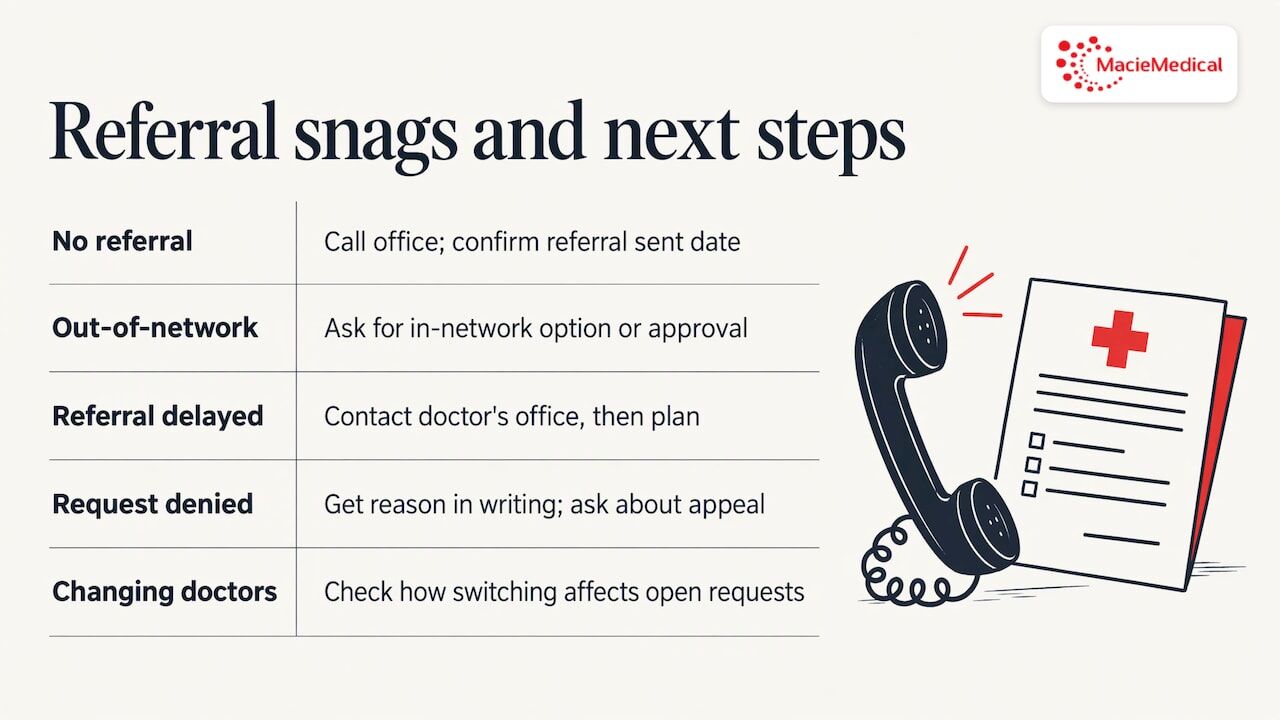
The specialist says they have no referral. Call your doctor’s office, confirm it was sent, and ask for the date. Offices handle many requests, and a gentle follow-up is normal.
The specialist is out of network. Ask your doctor for an in-network alternative, or ask your plan what out-of-network approval would require. The California regulator lists out-of-network doctors among the situations where prior approval may be needed.
The referral is delayed. Start with your doctor’s office, then your plan. New York’s Medicaid handbook, for example, tells members who have trouble getting a referral to contact plan Member Services. The member-services number on the back of your insurance card is the right place for any plan.
The request is denied. Ask for the reason in writing, ask your doctor whether more information could change the decision, and ask your plan how to appeal. Keep notes of who you spoke to and when.
You are changing doctors mid-process. If your plan ties referrals to a designated primary care provider, switching can affect open requests. Our step-by-step guide on how to switch primary care doctors walks through the order of operations.
A short checklist before any specialist visit
Bring this list to your primary care appointment:
- Your insurance card and plan name
- The question you want the specialist to answer
- Symptoms, how long they have lasted, and what makes them better or worse
- Current medications and supplements
- Recent lab and imaging results
- Your preferred location, days, and whether telehealth is possible
If you have lab work due, our on-site lab services can help you have results ready for the visit.
Our perspective: a referral works best inside a relationship
We named our practice Macie, which means “gift,” because we believe patients deserve time, attention, and respect. A referral is one of the moments that idea matters most. Sending you to a specialist should not feel like being handed off.
Dr. Judith Aniekwena is board certified in internal medicine and obesity medicine, and our approach is built around treating you as a whole person, not a list of symptoms. When one physician knows your blood pressure, your weight, your lab trends, and your goals, the question “Do I need a specialist?” has a better answer, and the referral that follows says more.
We emphasize coordinated care and ongoing communication, and we want every patient to leave understanding their plan. If you leave not knowing why you are being referred, who you are seeing, or what happens next, ask us to explain until it is clear. That is our job.
Macie Medical
Make your next step a manageable one
If you are looking for a primary care home base in Katy, we offer adult primary care, annual physicals, same-day sick visits, women’s health, medical weight loss, immigration medical exams, and chronic care management, along with in-person and telehealth visits. You can see everything on our services page, start with an annual physical, or review our cash pay options if you are paying without insurance. As of November 16, 2026, we welcome patients at our new, larger office at 633 E Fernhurst Dr, Suite 205, Katy, TX 77450. Call or book online to schedule your visit.
If you are new to our area and still choosing a doctor, our adult primary care guide explains what to look for.
FAQ
Do I need a referral to see a specialist?
It depends on your health plan. Some plans, often HMOs, require a referral from your primary care provider, while others let you book directly but may still require prior authorization for certain services. Check your plan documents or call the member-services number on your insurance card before you book.
What is the difference between a referral and prior authorization?
A referral is your primary care provider’s order to see a specialist or receive a service. Prior authorization is your health plan’s approval before it covers a service or prescription. Depending on your plan, you may need one, both, or neither, and a plan may decline to pay if a required one was skipped.
How long does it take to get a referral?
The time varies by plan and by how quickly the specialist can see you. Published examples range from a few days to about five business days for a plan’s decision, with faster timelines when a doctor marks a request urgent. Ask your doctor’s office and your plan for their current timeline, and mention it if your symptoms are getting worse.
Can I get a referral through a telehealth visit?
Often yes, when your doctor can evaluate your concern by video and decides a specialist is appropriate. Whether your plan accepts it is a matter of plan rules, so ask. We offer telehealth appointments for patients anywhere in Texas.
What should I do if I need a specialist right away?
For an emergency, go to emergency care or call 911 and sort out paperwork afterward. For an urgent concern that is not an emergency, call your primary care office the same day, ask them to mark the request urgent, and ask your plan about expedited review.
Sources
- NAIC: Understanding health insurance referrals and prior authorizations
- California DMHC: Referrals and Approvals
- New York State Medicaid Managed Care Model Member Handbook
- Kern Family Health Care: Get the care you need
- American Academy of Pain Medicine: When to refer to a pain specialist
- Colorado Doctors Plan HMO Network Access Plan
- HMO and PPO plan differences