
Comprehensive primary care means one practice takes responsibility for most of your physical and mental health needs: prevention, sick visits, and ongoing care for conditions like high blood pressure or diabetes. The federal Agency for Healthcare Research and Quality (AHRQ) describes a primary care medical home as accountable for meeting the large majority of each patient’s health care needs, including prevention and wellness, acute care, and chronic care. At Macie Medical in Katy, that is the kind of home base we build with each adult patient, with time to listen and a plan you leave understanding.
TL;DR
- Comprehensive primary care covers prevention, short-term illness, chronic condition management and coordination with specialists, all through one trusted doctor.
- Most adults need a handful of age-based screenings, such as blood pressure checks from age 18, colorectal cancer screening from 45 and mammograms from 40 for women.
- Your personal history, sex, weight and smoking history change which screenings you need and when.
- The best practices offer same-day access, on-site labs and a clear follow-up plan, so care does not stall between visits.
- Macie Medical offers adult primary care, annual physicals, same-day sick visits, women’s health, medical weight loss and on-site labs in Katy, plus telehealth anywhere in Texas.
Table of Contents
- What comprehensive primary care means
- Services a comprehensive primary care practice should cover
- Coordination: the part patients rarely see
- Adult screenings by age
- How your history changes the schedule
- Chronic conditions: where continuity pays off
- Weight, hormones and whole-person care
- What to look for in a comprehensive primary care practice
- Why a comprehensive approach beats episodic visits
- Start with one visit
- FAQ
- Sources
What comprehensive primary care means
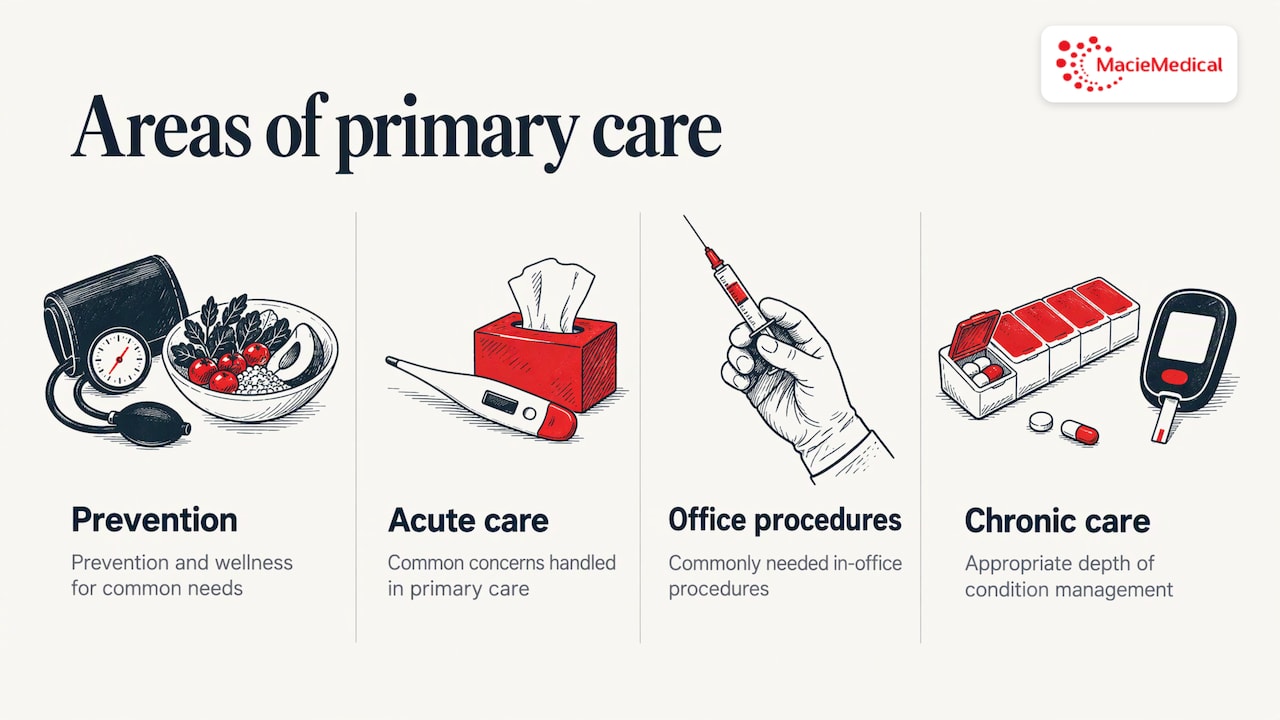
The phrase sounds like marketing, but it has a working definition in health policy. A 2021 peer-reviewed article describes comprehensiveness as the extent to which a primary care clinician and team recognize and meet the majority of each patient’s physical and common mental health needs. That includes prevention and wellness, acute care for common concerns, commonly needed office-based procedures, and an appropriate depth of chronic condition management.
Put simply, the breadth of what your practice can handle should match what patients like you most often need. AHRQ’s white paper on redefining primary care says comprehensiveness is measured by how well a practice’s services match the most common needs of its patients. Health problems that occur often enough for a clinician to stay skilled at them belong in primary care.
Researchers also treat comprehensiveness as one of the features that sets primary care apart from other kinds of care, alongside accessibility, continuity, coordination and accountability for the whole person. In everyday terms, you should not have to find a new office for every new problem.
What it is not
It is not a single visit, a long list of tests, or a clinic that treats only one condition. A comprehensive practice is a relationship. You come in when you are well, when you are sick, and when a long-term condition needs adjusting, and the same team knows your history each time.
Services a comprehensive primary care practice should cover
The Society of General Internal Medicine describes comprehensive primary care as providing acute care, chronic disease management, preventive care, coordination of care across the medical spectrum, and outreach to at-risk populations. Practices that go further also address mental health, nutrition, social factors that affect health, transitions of care and longitudinal care management.
The Johns Hopkins Primary Care Policy Center adds that the range includes prevention, coaching and counseling, care for acute and chronic illnesses and injuries, minor procedures, behavioral health and community resource information. Here is how that looks in practice for an adult in the Katy area.
| Need | What comprehensive care does | How we handle it at Macie Medical |
|---|---|---|
| Staying well | Yearly exam, screenings, vaccines review, risk assessment | Annual physical exams with personalized follow-up |
| Feeling sick today | Prompt evaluation of common illness | Same-day sick visits and urgent care services |
| Ongoing conditions | Diabetes, high blood pressure and thyroid disorders managed over time | Chronic disease management |
| Women’s health | Well-woman exams, Pap smears, birth control, menopause care | Women’s health services |
| Weight | Physician-supervised plans, GLP-1 medication when appropriate | Medical weight loss led by a board-certified obesity medicine doctor |
| Testing | Blood work and screening labs | On-site lab services |
| Immigration | USCIS Form I-693 medical exam | Immigration medical exams completed accurately and efficiently |

Coordination: the part patients rarely see
Good primary care does quiet work between appointments. AHRQ explains that the medical home coordinates care across the broader health care system, including specialists, hospitals, home health care and community services. It calls this especially critical during transitions, such as leaving the hospital.
For you, that means a specialist’s findings land in the same record as your lab results and medication list, and someone connects the dots. Your own records matter here too. Keeping your documents organized helps every doctor you see, and patient data and health outcomes are closely linked.
Adult screenings by age
Prevention is the largest part of comprehensive care for most healthy adults. The U.S. Preventive Services Task Force (USPSTF) is an independent expert panel whose recommendations guide most primary care offices. The table below draws on its A and B recommendations, the ones it rates as having a high or moderate net benefit.
| Screening | Who | How often |
|---|---|---|
| High blood pressure | Adults 18 and older | Office measurement, with readings outside the clinic to confirm a diagnosis before treatment |
| Prediabetes and type 2 diabetes | Adults 35 to 70 with overweight or obesity | Discuss timing with your doctor |
| Colorectal cancer | Adults 45 to 75 | Depends on the test you and your doctor choose; ages 76 to 85 are individualized |
| Breast cancer | Women 40 to 74 | Mammography every two years |
| Cervical cancer | Women 21 to 29 | Cytology (Pap test) every 3 years |
| Cervical cancer | Women 30 to 65 | Cytology every 3 years, or high-risk HPV testing alone or with cytology every 5 years |
| Lung cancer | Adults 50 to 80 with a 20 pack-year smoking history who smoke or quit within 15 years | Annual low-dose CT |
| Osteoporosis | Women 65 and older; postmenopausal women younger than 65 at increased risk | Bone density testing, timing guided by your doctor |
| Abdominal aortic aneurysm | Men 65 to 75 who have ever smoked | One-time ultrasound |
| Chlamydia and gonorrhea | Sexually active women 24 and younger; women 25 and older at increased risk | Based on risk |
A professional summary of USPSTF guidance from the American Academy of Family Physicians also lists depression screening for adults, hepatitis C screening for ages 18 to 79, and HIV screening for ages 15 to 65.
Two changes are worth knowing. The USPSTF’s 2024 breast cancer recommendation lowered the age to start routine mammography from 50 to 40. And colorectal screening now begins at 45 rather than 50, with the 2021 recommendation covering ages 45 to 49 as well.
A worked example
Imagine a 52-year-old woman in Cypress who has overweight, has never smoked and has no family history of cancer. Her list would include a blood pressure check, a diabetes screen, a mammogram every two years, colorectal screening, and cervical screening every 3 to 5 years depending on the test. A 58-year-old man who quit smoking 10 years ago after a 25 pack-year history would add an annual low-dose CT scan. The lists differ because the risks differ, which is why one doctor who knows your history matters.
For more on this age group, see our guide to health screenings after 40.
How your history changes the schedule
The table gives averages. Your family history, smoking history, weight, pregnancy history and existing conditions all move the dates. The USPSTF’s chlamydia and gonorrhea recommendation, for example, depends on age and on whether you are at increased risk for infection.
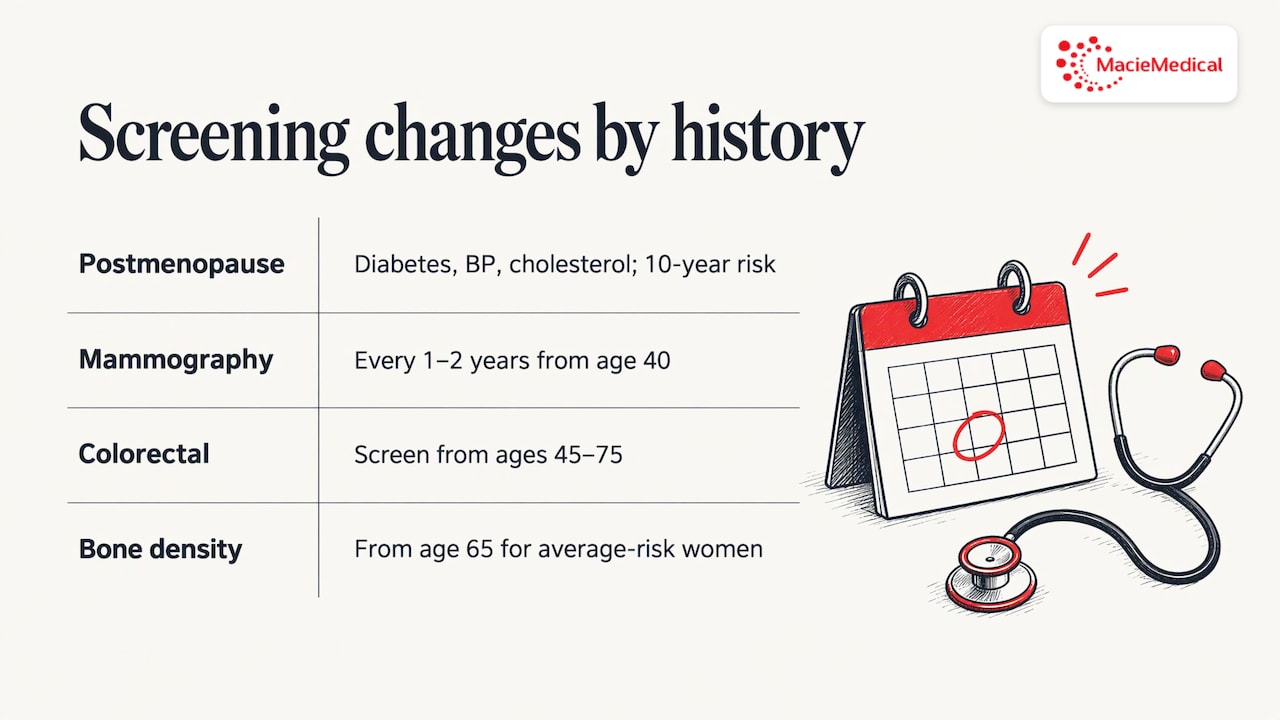
For women past menopause, the AAFP notes that cardiovascular disease is the leading cause of death for women in the United States. It recommends routine screening for diabetes, high blood pressure and abnormal cholesterol, with a 10-year cardiovascular risk score to guide management. The same article recommends mammography every 1 to 2 years from age 40, colorectal screening from 45 to 75, and bone density testing from age 65 for average-risk women.
If you are in perimenopause or menopause and unsure what to track, our women’s health checklist is a good starting point, and your next visit is the place to build a personal schedule.
Chronic conditions: where continuity pays off
If you live with high blood pressure, diabetes or a thyroid disorder, comprehensive care changes the rhythm of your year. Instead of treating each flare-up, your doctor tracks trends, adjusts medication, orders labs and checks in between visits. The SGIM notes that access to primary care has been shown to improve patient outcomes and lower cost.
That matters for seniors in particular, who often manage several conditions and medicines at once. Our pages on senior chronic care management and managing chronic diseases explain how ongoing care can feel personal rather than rushed.
Weight, hormones and whole-person care
Weight management and menopause are common reasons adults look for a new primary care doctor, and both fit naturally inside comprehensive care. At Macie Medical, medical weight loss is physician-supervised and led by a board-certified obesity medicine doctor, with GLP-1 medications such as tirzepatide included when appropriate. Menopause care sits alongside well-woman exams, Pap smears and birth control in our women’s health services.
Because these live under one roof with your primary care, your blood pressure, labs and medications are reviewed together instead of in separate silos.
What to look for in a comprehensive primary care practice
Use these questions when you choose a practice:
- Can you be seen quickly when you are sick? First-contact care means your primary care provider is the usual entry point for each new health need, except in serious emergencies. Same-day availability makes that real.
- Is the doctor trained for the breadth of adult care? Internal medicine training focuses on adults. Dr. Judith Aniekwena is board-certified in both internal medicine and obesity medicine.
- Are labs available on site? Fewer trips mean faster answers.
- Is telehealth an option? We offer telehealth appointments for patients anywhere in Texas.
- Do you leave understanding the plan? This is the simplest test of unhurried care.
Our guide to choosing an adult primary care clinic goes deeper on each point.
Why a comprehensive approach beats episodic visits
The 2021 research notes that most U.S. primary care grew up around fee-for-service payment, where physicians gave highly focused visits and often documented and referred patients with complex conditions. Many patients have felt the result: short appointments and a referral for anything complicated. A comprehensive practice is built to do the opposite, keeping as much care as appropriate in one trusting relationship.
Our perspective
We started Macie Medical on a simple promise: you will be heard here. The name “Macie” means “gift,” and that idea shapes how we care for every patient, with time, attention and respect.
To us, comprehensive primary care is about being your home base. It means a board-certified physician who can manage your blood pressure, review your lab work, talk through menopause or weight, and still have room to ask how you are doing. Dr. Aniekwena, who was named a Houstonia Top Doctor in Primary Care for 2026, treats patients as whole people, not a list of symptoms.
We work to keep care accessible and unhurried, with same-day sick visits, in-person and telehealth appointments, and a clear plan before you leave. When your needs change, we are already familiar with your story and ready to adjust.
Macie Medical
Start with one visit
If you do not have a primary care doctor, or yours rarely has time for you, a first visit is a manageable place to begin. We see adults from Katy, Cypress, Richmond and Memorial City in person, and from anywhere in Texas by telehealth. Our larger office at 633 E Fernhurst Dr, Suite 205, Katy, TX 77450 welcomes patients starting November 16, 2026.

Bring your medication list, any recent records and the questions on your mind. Browse our primary care services, read about our adult primary care in Katy, or see how our cash pay clinic works, then call or book online.
FAQ
What does comprehensive primary care mean?
It means one practice is responsible for most of your physical and common mental health needs. That includes prevention, treatment of short-term illness, and ongoing management of chronic conditions, with coordination when you see specialists.
How often should I get a physical?
Many adults schedule a yearly visit to review screenings, medications and risk factors. Your doctor may suggest a different pattern based on your age and conditions. Our annual physical exams include personalized follow-up.
Which screenings should I start in my 40s?
Women are advised to begin mammography at 40, and every adult should have colorectal cancer screening from 45, according to the USPSTF. Adults 35 to 70 with overweight or obesity should also be screened for prediabetes and type 2 diabetes. Your doctor will tailor the timing to your history.
Can I get comprehensive care if I need to be seen the same day?
Yes. At Macie Medical we offer same-day sick visits and urgent care services alongside ongoing primary care, so a sudden illness is handled by a team that already knows you.
Do you offer telehealth?
Yes. We offer telehealth appointments for patients anywhere in Texas, in addition to in-person visits in Katy.
Sources
- Defining the PCMH, Agency for Healthcare Research and Quality
- Redefining Primary Care for the 21st Century, AHRQ white paper
- Comprehensiveness: the need to resurrect a sagging pillar of primary care
- Measuring comprehensiveness of primary care: challenges and opportunities
- Primary Care Assessment Tools, Johns Hopkins Primary Care Policy Center
- What is comprehensive primary care, Society of General Internal Medicine
- USPSTF A and B recommendations
- USPSTF health care schedule 2024, AAFP
- Evidence considerations for recent USPSTF recommendations, AAFP
- Health maintenance in postmenopausal women, American Family Physician
- The role of patient data in healthcare outcomes