
For most adults in Texas, the best diabetes management doctor is a primary care physician you can see often, who knows your whole health history and coordinates everything else around it. Diabetes is a long-term condition, so what matters most is steady follow-up, clear explanations and a plan that fits your life. A specialist can join your team when you need one. At Macie Medical in Katy, Dr. Judith Aniekwena is board-certified in internal medicine and obesity medicine, and we care for adults with diabetes alongside blood pressure, thyroid and preventive needs. You can read about our diabetes care in Katy.
This guide explains what the different kinds of diabetes doctors do, what good ongoing care looks like, and how to choose a practice in Texas.
TL;DR
- A doctor who specializes in diabetes is called an endocrinologist, but most adults start with a primary care physician, who can manage diabetes day to day and refer when needed.
- Good management means regular A1C checks (at least twice a year), kidney, eye and foot checks, and a written plan you understand.
- Choose a doctor who listens, accepts your insurance, coordinates with other clinicians and is easy to reach between visits.
- Telehealth, on-site labs and same-day visits make it easier to stay on schedule.
- We offer in-person care in Katy and telehealth for patients anywhere in Texas.
Table of Contents
- What is a diabetes doctor called?
- Why primary care is a strong home base for diabetes
- What good diabetes management looks like
- Screenings and complications to keep on your calendar
- How to choose a diabetes management doctor in Texas
- Get more out of every diabetes visit
- Weight, blood pressure and the rest of your health
- Making access easier: same-day, telehealth and labs
- Start with a diabetes plan at Macie Medical
- Our perspective on diabetes care
- Frequently asked questions
- Sources
What is a diabetes doctor called?
The title most people search for is endocrinologist. An endocrinologist is a doctor who specializes in diabetes and other conditions of the endocrine system, the glands that make hormones such as insulin.
But endocrinologists are only one part of the picture. The American Diabetes Association (ADA) lists a wider team that can include primary care professionals, eye-care professionals, podiatrists (foot doctors), pharmacists, dentists, nurses or navigators, registered dietitians, diabetes care and education specialists, mental health professionals and fitness professionals. You do not need every one of them. You need someone who helps you decide who belongs on your team and keeps the pieces connected.
That is the job of your primary care physician (PCP). The CDC describes a PCP as usually a general or family doctor who provides routine medical care, typically including yearly checkups, physical exams, lab tests and prescriptions. Internal medicine physicians, like Dr. Aniekwena, focus on adult care, which includes long-term conditions such as diabetes.
Why primary care is a strong home base for diabetes
Your health needs a home base. Diabetes touches your heart, kidneys, eyes, nerves, weight, sleep and mood, and a doctor who sees the whole picture can spot how those pieces affect each other.
The American Heart Association says a family doctor is often the main point of contact for diabetes care, should be seen more than once a year, and can address overall health and lifestyle and refer you to specialists when appropriate. The CDC adds that your PCP may refer you to an endocrinologist, and that the endocrinologist can in some cases become the main doctor helping manage your diabetes.
In practice, a primary care relationship gives you:
- One person who knows your history. Blood pressure, cholesterol, thyroid results and diabetes numbers are read together, not in isolation.
- Prescriptions and lab orders in one place. Your PCP handles routine labs and medication adjustments.
- A natural path to referrals. The CDC suggests discussing a referral with your PCP when you have foot sores or vision problems, or when other treatments are not helping. Your PCP can coordinate it and keep the results in your chart.
- Preventive care on the same schedule. Screenings, vaccines and annual physicals can be planned around your diabetes visits.
If you want the longer explanation, we cover it in Can Primary Care Doctors Treat Diabetes?
What good diabetes management looks like
Management is not one appointment. It is a cycle of measuring, adjusting and supporting. Here is what a well-run plan covers.

Regular A1C checks and individual goals
A1C is a blood test that reflects your average blood sugar over the past few months. The ADA’s 2026 Standards of Care say glycemic status should be assessed at least twice a year, and more often if goals are not being met, treatment changes, low or high blood sugar episodes are frequent or severe, or your health status changes.
The same ADA section says an A1C below 7% is appropriate for many nonpregnant adults who do not have severe or quality-of-life-affecting low blood sugar, while goals should be individualized. That last point matters. Your goal depends on your age, other conditions, medications and daily life, so it should be set with your doctor and not copied from a chart.
A written diabetes management plan
The CDC advises looking for care-team members who listen, support and respect your needs, preferences and values, and says your team should develop a diabetes management plan with you. A useful plan names your targets, your medications and when to take them, how and when to check your blood sugar, what to do when numbers run high or low, and when your next visit and labs are due.
Technology and medication
The ADA announced its 2026 Standards on December 8, 2025. Its release highlights updated guidance on diabetes technology, glucose-lowering therapies, blood pressure goals for specified risk groups, behavioral health screening, and kidney and cardiovascular care. It also says continuous glucose monitoring (CGM) is recommended at diabetes onset and afterward for anyone who could benefit. A CGM is a small wearable sensor that tracks glucose through the day. Ask at your next visit whether it could fit your situation and what your insurance covers.
The ADA revises its Standards every year, so the recommendations your doctor follows will keep evolving. A practice that stays current explains what changed and why it matters to you.
Support for daily habits
The CDC points to diabetes care and education specialists as the professionals who provide personalized diabetes self-management education and support, and advises asking your doctor for a referral. Food, movement, sleep and stress are the daily parts of management that no prescription replaces, so a doctor who talks about them without judgment is worth having.
Screenings and complications to keep on your calendar
Diabetes can affect parts of the body that do not hurt until a problem is advanced, which is why checks happen on a schedule. The CDC tells people with diabetes to discuss regular kidney checks, eye exams and prompt attention to foot or leg sores with their doctor.
A few specifics from the ADA’s 2025 revisions to its Standards of Care:
- Eye exams. The revision summary says an ophthalmologist should be involved more frequently when retinopathy is progressing or sight-threatening. Retinopathy is damage to the blood vessels of the retina.
- Circulation in the legs. The same summary adds ankle-brachial-index screening for peripheral artery disease in people with diabetes who are 65 or older, in people with certain microvascular or foot complications when the diagnosis would change management, and for consideration in some people who have had diabetes for at least 10 years and have high cardiovascular risk. This is a simple test comparing blood pressure in your ankle and arm.
Do not wait for a scheduled visit if you notice a foot sore that is not healing, sudden vision changes, or symptoms of very high or very low blood sugar. Call your doctor the same day, and if you have severe symptoms such as confusion, trouble breathing or fainting, call 911.
Many of these checks begin with blood and urine tests. Our on-site lab services are meant to keep that part simple. Our overview of essential health tests shows how they fit into routine care.
How to choose a diabetes management doctor in Texas
Texas is big, and your doctor should be close enough, or reachable enough, that you will actually go. Use these criteria.
- Start with convenience. The ADA suggests starting with a convenient primary care clinician and asking trusted people, your current clinician, or diabetes education programs and support groups for recommendations. A practice you can reach easily is a practice you will keep going to.
- Confirm insurance. The ADA advises checking whether a doctor accepts your insurance, either through your plan or by contacting the practice, and cautions that ratings websites can be inaccurate or out of date. Call the office and ask directly.
- Ask how care is coordinated. Ask how the practice handles labs, referrals and communication with other clinicians, and how you reach the office between visits.
- Look for a doctor who listens. The CDC’s advice to find team members who respect your preferences and values is a practical test. After the first visit, ask yourself whether you understood the plan and felt heard.
- Check the access options. Same-day appointments and telehealth matter when your numbers change or work makes a trip hard.
Texas Medicaid plans can include extra diabetes-related services. A Texas Health and Human Services comparison for the Dallas area lists plan-specific extras, including diabetic eye exams, A1C testing and diabetes program supports, though availability depends on the plan and area. If you are on a STAR plan, check what yours offers before your first visit.
Our guides to choosing a Texas primary care physician and choosing a family doctor in Texas walk through the same decision in more detail.

Get more out of every diabetes visit
The ADA’s team guidance stresses that you are an active member of your care team: tell your doctors about symptoms and concerns, and bring written questions to appointments. A short checklist helps:
- Your blood sugar readings or CGM report, plus any lows or highs and what was happening at the time.
- A list of every medication and supplement you take, including doses.
- Notes on your feet, vision, energy, thirst, sleep and mood.
- Two or three questions you want answered before you leave.
- Any questions about cost, refills or what labs are due next.
Before you go, ask the doctor to repeat the plan back in plain words. At Macie Medical we work to make sure every patient leaves understanding their plan.
Weight, blood pressure and the rest of your health
Diabetes rarely travels alone. Weight, blood pressure, cholesterol and thyroid health all shape how you feel and how your numbers behave. The ADA’s 2026 release names blood pressure goals and cardiovascular and kidney care among its updates, which is a reminder that the plan is wider than blood sugar.
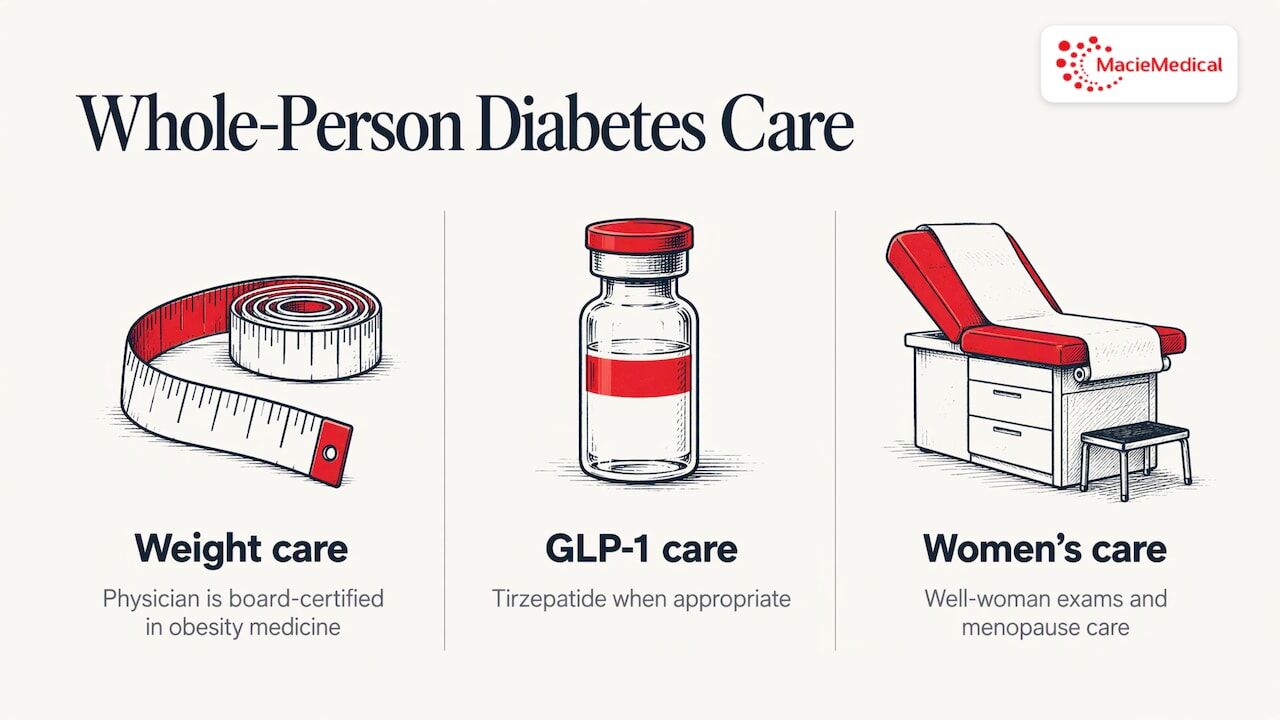
If weight is part of your story, it helps to see a physician who is trained in it. Dr. Aniekwena is board-certified in obesity medicine as well as internal medicine, and our physician-supervised weight loss programs include GLP-1 medications such as tirzepatide when appropriate. Whether a medication makes sense for you depends on your history, your other prescriptions and your goals, and it is a decision made in the exam room. Our page on GLP-1 doctors and how to choose one explains what to expect, and our weight loss program page describes how we approach it.
Women managing diabetes alongside menopause or other hormonal changes can also bring those questions to the same practice. We provide well-woman exams, birth control and menopause care, so you do not have to explain your history twice.
Making access easier: same-day, telehealth and labs
Diabetes management works best when small problems get handled early. A few features of our practice are built around that idea:
- Same-day sick visits. An illness can push blood sugar off course. We offer prompt appointments when you need to be seen quickly.
- Telehealth anywhere in Texas. Follow-up conversations about readings, refills and plan changes can happen by video. See our telemedicine in Katy page.
- On-site lab services. Routine blood work can be part of your visit.
- A patient portal. Messages, results and visit information are available through our secure patient portal.
We serve patients from Katy, Cypress, Richmond and Memorial City. If you are closer to the city, our page on diabetes treatment in Houston covers how we work with patients there.
Start with a diabetes plan at Macie Medical
If you want a doctor who will take time with you, we would be glad to see you. Our diabetes management program explains what it includes and how to begin in Katy and Houston, and our primary care services cover chronic care, preventive screenings and annual physicals. Since November 16, 2026, we have welcomed patients at our new, larger office at 633 E Fernhurst Dr, Suite 205, Katy, TX 77450.

We bill insurance and also offer self-pay options. You can see how that works on our cash pay page. To get started, call or book online, and bring your latest labs and medication list if you have them.
Our perspective on diabetes care
Macie means “gift,” and that idea shapes how we care for people living with diabetes. A condition you manage for years deserves a doctor who gives it time, attention and respect.
We believe the strongest diabetes care starts with being heard. Your numbers matter, and so do your work schedule, your family, your faith, your budget and what you are afraid of. Dr. Aniekwena treats patients as whole people, not a list of symptoms, and as a physician board-certified in both internal medicine and obesity medicine, she looks at how weight, blood pressure, hormones and blood sugar fit together.
That is why we think primary care is such a good home base. One practice can handle your chronic care, your labs, your annual physical, your sick visits and your telehealth follow-ups, and can help you find the right additional clinicians when your care calls for them.
Our goal is simple: every patient leaves knowing the plan, and feeling that the next step is manageable.
Macie Medical
Frequently asked questions
What kind of doctor should I see for diabetes in Texas?
Most adults start with a primary care physician, such as an internal medicine or family doctor, who can order labs, adjust medications and coordinate your care. An endocrinologist is the specialist in diabetes and hormone conditions, and your PCP can discuss a referral if your situation calls for it.
How often should I see my doctor for diabetes?
The ADA’s 2026 Standards say to assess glycemic status at least twice a year, and more often if you are not meeting goals, your treatment changes, or your health changes. The American Heart Association says to see your family doctor more than once a year. Your doctor will set your schedule.
Can I manage diabetes with telehealth?
Many follow-up conversations, such as reviewing readings, refills and plan changes, can happen by video. Labs and physical checks such as foot exams still happen in person. We offer telehealth appointments for patients anywhere in Texas.
What should I bring to my first diabetes appointment?
Bring your medication list, recent lab results, any glucose readings or CGM reports, and written questions. Also bring your insurance card, so the office can confirm your coverage before the visit.
Sources
- Your Healthcare Team | American Diabetes Association
- Your Diabetes Care Team | CDC
- Getting Quality Care | CDC Your Diabetes Compass
- Working with Your Diabetes Healthcare Team | American Heart Association
- Glycemic Goals, Hypoglycemia, and Hyperglycemic Crises: Standards of Care in Diabetes 2026
- Summary of Revisions: Standards of Care in Diabetes 2025
- American Diabetes Association Releases Standards of Care in Diabetes 2026
- Finding a New Physician | American Diabetes Association
- Compare Extra Services STAR Medical Plans Offer in the Dallas Area | Texas HHS