

Virtual primary care means having a personal doctor you see by video or phone for ongoing care: check-ups, chronic conditions, prescriptions, lab follow-up and sick visits. It is different from a one-time online visit with whoever is available, because the same practice knows your history and follows your health over time. At Macie Medical, Dr. Judith Aniekwena and our team offer telehealth appointments to patients anywhere in Texas, alongside in-person visits in Katy, so your care can move between the screen and the exam room without starting over.
TL;DR
- Virtual primary care is ongoing care with a doctor who knows you, delivered by video or phone, not a single anonymous online visit.
- Telehealth can cover wellness visits, prescriptions, nutrition counseling, common urgent problems and remote monitoring, according to the CMS patient toolkit.
- Under Original Medicare, most telehealth services are paid the same way as an in-person visit, so the usual deductible and 20% coinsurance apply. Private plans and Medicaid vary by state and plan.
- Some things still need hands-on care: physical exams, certain lab work and emergencies. A practice that offers both formats makes that handoff simple.
- Macie Medical offers telehealth appointments to patients anywhere in Texas, plus in-person care in Katy.
Table of Contents
- What virtual primary care actually is
- How an online primary care visit works
- What a virtual primary care doctor can handle
- When you need to be seen in person, or go to the ER
- What a virtual doctor visit costs and what insurance covers
- Telehealth rules: what has changed
- How to choose a virtual primary care doctor
- Who benefits most from virtual primary care
- Promo: care from home, with a doctor who knows you
- Our perspective
- FAQ
- Sources
What virtual primary care actually is
Primary care is the medical home base for your everyday health: prevention, diagnosis of new problems, management of long-term conditions and coordination with specialists. Virtual primary care delivers much of that through a secure video or phone visit instead of an office visit.
The word that matters is primary. A one-off telehealth visit treats the problem in front of it. Virtual primary care is built around a relationship. One health-care industry publication makes the same distinction: continuity, seeing the same clinician consistently, is what separates effective primary care from isolated telehealth encounters.
That difference shows up in practical ways:
- Your doctor already knows your blood pressure trend, your A1C, your medication list and your family history.
- Refills, lab review and follow-up questions go to someone who can see the full picture.
- If you do need to be examined in person, the same practice can see you, rather than sending you to a stranger.
The American Academy of Family Physicians takes the same view. Its telehealth policy says telemedicine should meet the same standard of care as in-person visits in most states, and that patients should be connected to their primary care physician for ongoing care.
How an online primary care visit works
A virtual visit is simpler than most people expect.
- Schedule. You book through the practice, by phone or online. Same-day sick visits are available at Macie Medical when you need to be seen quickly.
- Prepare. Choose a quiet, private spot with a phone, tablet or computer. Have your medication list, recent readings (blood pressure, glucose, weight) and your questions written down. If you have a home blood pressure cuff, keep it nearby.
- Connect. You join through a secure link or call. The AAFP policy notes that patients should be able to take visits from privacy-supporting locations, including home. Telehealth platforms are expected to be HIPAA compliant, as the AAAAI’s summary of federal telemedicine policy points out.
- Talk it through. Your doctor asks about symptoms and history, looks at what can be seen on video, and reviews any numbers you have collected.
- Leave with a plan. That might be a prescription sent to your pharmacy, lab orders, a follow-up date or an in-person appointment. Our team works to make sure every patient leaves understanding the plan.
One rule worth knowing: telehealth is regulated by the state where you are during the visit. The AAAAI explains that federal Medicare rules defer to state law on licensure, and the state laws that apply are based on the patient’s location. That is why a Texas practice serves patients who are in Texas, and why we offer telehealth to patients anywhere in the state.
What a virtual primary care doctor can handle
The CMS toolkit, Telehealth: What to Know for Your Family, lists the kinds of care telehealth can provide: general health care such as wellness visits and prescriptions, nutrition counseling, dermatology, remote monitoring, and urgent care for common conditions like sinus infections, back pain, urinary tract infections and rashes.
For our patients, that translates into several everyday uses.
Ongoing care for chronic conditions
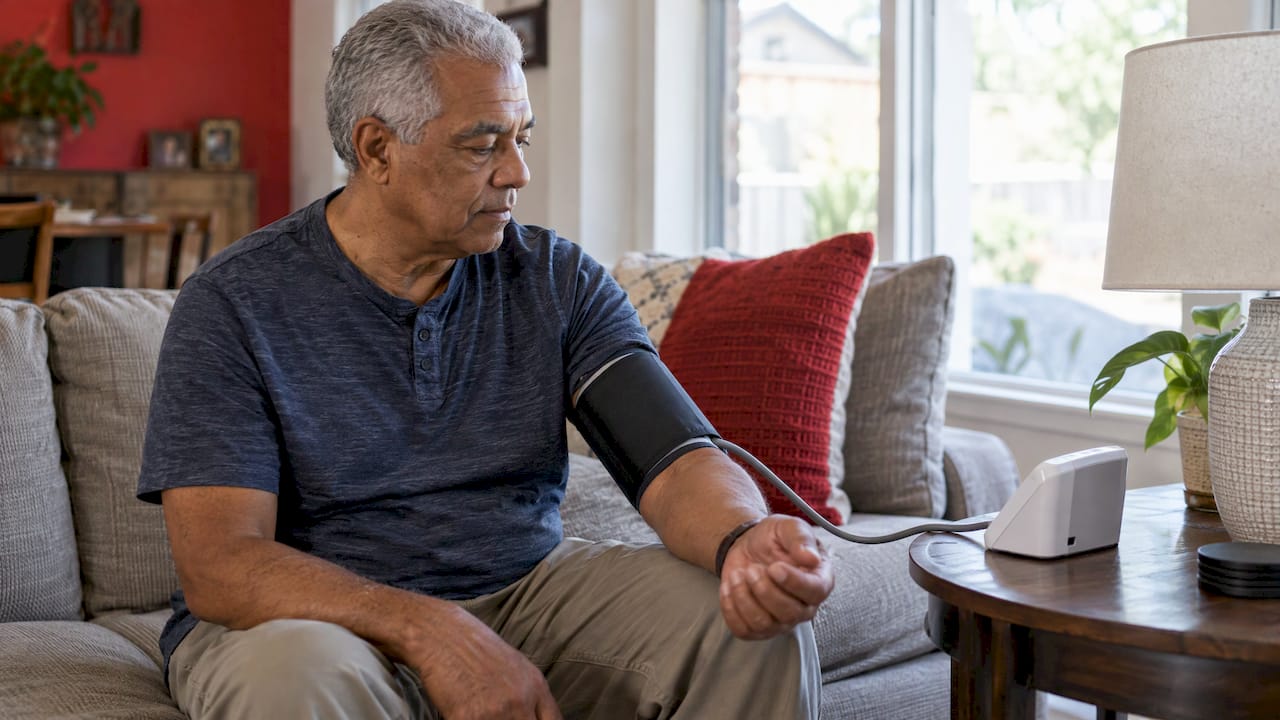
Diabetes, high blood pressure and thyroid disorders depend on steady attention rather than occasional visits. Between in-person check-ups, a video visit lets your doctor review home readings, adjust medication and answer questions while a change is still small. Our chronic care management services are built around that kind of continuing contact.
Sick visits and common illnesses
Cold and flu symptoms, sinus trouble, rashes, urinary symptoms and similar problems are often well suited to a virtual visit. If you wake up unwell and want an answer today, our virtual doctor visits let you be seen without driving across Katy or sitting in a waiting room.
Weight management
Weight care is conversation-heavy: eating patterns, sleep, medication response, side effects, motivation. Dr. Aniekwena is board-certified in both internal medicine and obesity medicine, and our physician-supervised medical weight loss program includes GLP-1 medications such as tirzepatide when appropriate. Check-ins fit naturally into a virtual format.
Women’s health and menopause care
Hot flashes, sleep disruption, mood changes and birth control questions are discussions first and exams second. Many of those conversations work well by video. Well-woman exams and Pap smears happen in the office, and we coordinate the two so you are not repeating your story. You can read more about our well-woman exams.
Medication refills and prescriptions
Routine refills and adjustments are among the most common reasons for a virtual visit. Controlled substances carry stricter rules: federal policy summarized by the AAAAI notes that prescribers must see a patient face to face before administering controlled substances, and state boards add their own requirements. Your doctor will explain what applies to you.
Preventive care and wellness
Prevention is more than the exam itself. Reviewing your screening schedule, vaccines and risk factors can happen virtually, and the hands-on pieces can be scheduled in person. For Medicare patients, our annual wellness exam page explains what that visit includes.
When you need to be seen in person, or go to the ER
Virtual care works best when your doctor can learn what they need from conversation, a visual check and your own measurements. Some situations call for hands, instruments or equipment.
- In-person visit: a physical exam, a Pap smear, an immigration medical exam (USCIS Form I-693), blood draws and other lab work, listening to your heart and lungs, or a problem that is not improving after a virtual visit. Our on-site lab services keep testing in the same practice.
- Emergency care: call 911 or go to the nearest emergency room for chest pain or pressure, trouble breathing, signs of a stroke, severe bleeding or loss of consciousness. Do not wait for a telehealth appointment.
This is not a limit of virtual care so much as a normal rhythm of primary care. A practice that does both formats can move you from screen to exam room within the same relationship. Our telemedicine in primary care page describes how that fits together.
What a virtual doctor visit costs and what insurance covers
Cost depends on your coverage, so start with the plan you have.
Original Medicare. The CMS toolkit says that for most telehealth services Medicare pays the same as for an in-person visit, with your Part B deductible applying and a 20% coinsurance of the Medicare-approved amount. Medicare also covers brief patient-initiated virtual check-ins. The National Institute on Aging adds that what you owe depends on the service, the setting and any other insurance. The HHS telehealth billing guide lists the standard office-visit codes and the annual wellness visit codes (G0438 and G0439) that Medicare accepts by telehealth, and notes that Medicare Advantage plans may cover additional services or lower cost-sharing.
Medicaid and private insurance. Many cover telehealth, but the NIA notes that coverage varies widely from state to state and plan to plan, so confirm with your insurer or with the practice’s billing team before your visit.
Paying out of pocket. Some patients prefer self-pay. Our cash pay clinic page covers our cash pay and telemedicine cash pay services.
Whatever the payer, the AAFP’s position is that telemedicine involves the same physician work, judgment and liability as an in-person visit. Imaging and screening tests ordered after a virtual visit are billed separately, and what you pay depends on coverage; for example, you can see what a DEXA scan costs with and without insurance.
Telehealth rules: what has changed
Telehealth rules moved quickly during and after the COVID-19 public health emergency. Here is the short version for patients.
- The public health emergency ended on May 11, 2023, and some flexibilities became permanent while others expired at the end of 2024, according to the AAAAI.
- KFF reports that Medicare telehealth is available in urban and rural areas, including from your home, covers an expanded list of services and allows audio-only for many of them. Since 2026, CMS has simplified how new services are added to the covered list.
- Use is still well above where it was before the pandemic: KFF found 12.5% of eligible traditional Medicare beneficiaries received a telehealth service in the second quarter of 2025, compared with 6.9% in the first quarter of 2020.
Because Medicare telehealth policy is set by Congress and CMS and has been renewed in stages, check Medicare.gov or call our office to confirm what applies when you book. We handle the billing questions so you do not have to decode them alone.

How to choose a virtual primary care doctor
A good virtual practice should answer yes to these questions.
- Is the clinician board-certified and licensed in your state? State law follows your location, so a Texas-licensed physician is the right fit for a Texas patient.
- Will you see the same doctor? Continuity is what makes primary care work. Ask whether visits are with your own physician or whoever is on the schedule.
- Can you be seen in person when needed? The ideal is one practice that offers both formats, with labs and exams close at hand.
- Is your privacy protected? Look for a HIPAA-compliant platform and a secure patient portal.
- Does the practice fit your needs? If you manage diabetes, blood pressure, weight or menopause symptoms, you want a doctor experienced in those areas, not a general on-demand service.
- Is billing clear? Know in advance whether your insurance applies or what the self-pay rate is.
Our guides on choosing a primary care doctor and primary care for seniors walk through these questions in more detail.
Who benefits most from virtual primary care
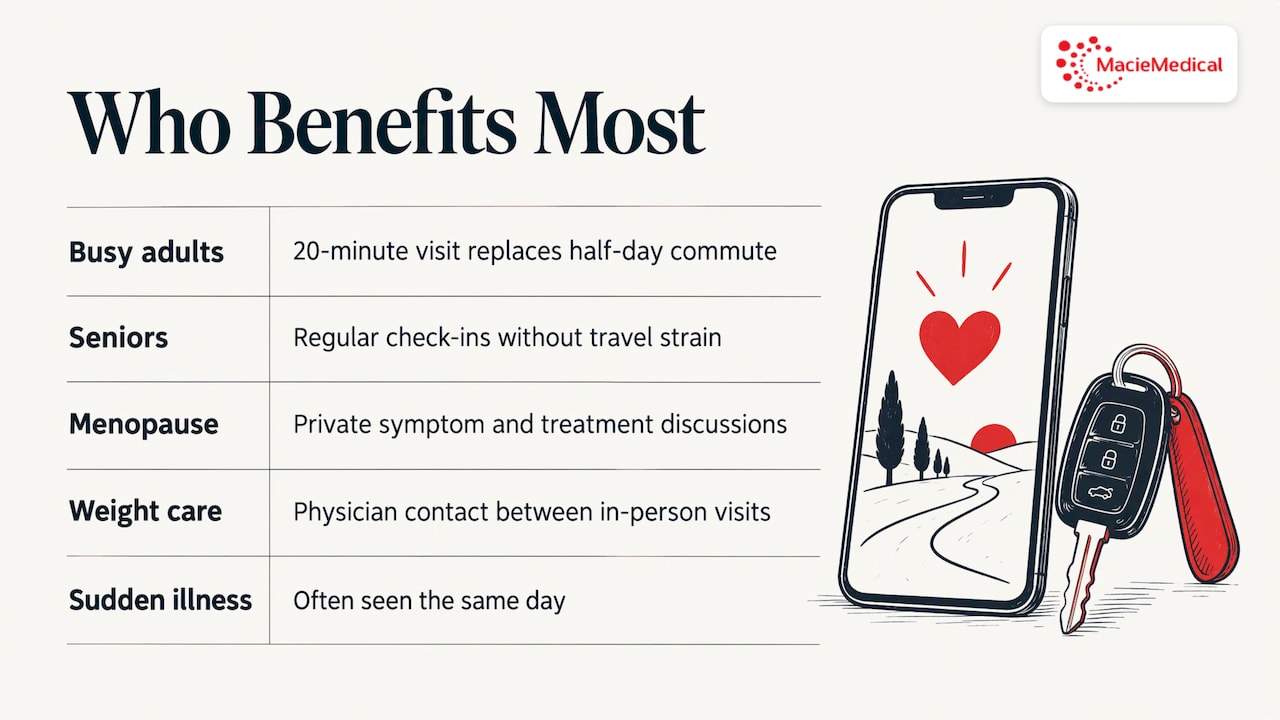
Busy working adults often find that a 20-minute video visit replaces half a day of driving and waiting. Seniors managing several conditions can have regular check-ins without the strain of travel. Women in perimenopause or menopause can talk through symptoms and treatment options in privacy and comfort. People working on their weight can keep regular contact with a physician between in-person visits. And anyone with a sudden illness can be seen quickly, often the same day.
For Katy, Cypress, Richmond and Memorial City patients, the convenience of telehealth adds to the Houston-area commute reality: fewer trips, less time lost, and care that fits your life.
Promo: care from home, with a doctor who knows you
Macie Medical is a primary care practice in Katy built on one promise: you will be heard here. Telehealth appointments are available to patients anywhere in Texas, and in-person visits are available in Katy. Our new, larger office is at 633 E Fernhurst Dr, Suite 205, Katy, TX 77450. Whether you want a long-term physician, help reaching a healthy weight or a same-day visit, you can start with a call or book online through our services page.

Existing patients can use the secure patient portal to stay connected between visits.
Our perspective
We built Macie Medical around a simple idea: people do better when a doctor has time to listen. Virtual care should serve that idea, not replace it.
For us, telehealth is one more way to be present. A video visit lets a patient with high blood pressure share their home readings, lets a woman in menopause describe what her nights are like, and lets a busy parent get answers without losing an afternoon. The conversation stays the same: attention, respect and a plan you understand.
That is why we pair telehealth with in-person care. Dr. Aniekwena is board-certified in internal medicine and obesity medicine, and patients see a physician who treats them as whole people, not a list of symptoms. When a visit needs an exam, a lab draw or a closer look, it happens in our office, with the same team that already knows your story.
If your health needs a home base, we would be glad to be yours.
Macie Medical
FAQ
What is virtual primary care?
Virtual primary care is ongoing care with a personal doctor delivered by video or phone. It covers check-ups, chronic condition management, prescriptions, lab follow-up and sick visits. Unlike a one-time online visit, it builds on your history with the same practice.
Is telehealth primary care as good as an in-person visit?
For many concerns, yes. The AAFP states that in most states telehealth is held to the same standard of care as in-person care. Some needs, such as a physical exam or lab work, still require an office visit, which is why a practice offering both works well.
Does Medicare cover virtual primary care visits?
Original Medicare covers many telehealth services, and for most of them payment matches an in-person visit, with the Part B deductible and 20% coinsurance applying, according to CMS. Medicare Advantage plans may offer additional telehealth benefits. Call our office with your plan details and we can help you confirm your coverage.
Can I see Macie Medical by telehealth if I live outside Katy?
Yes, if you are in Texas during the visit. We offer telehealth appointments to patients anywhere in the state, and we also see patients in person from Katy, Cypress, Richmond and Memorial City.
Can I get a same-day visit online?
We offer same-day sick visits for patients who need to be seen quickly, and virtual doctor visits are one way to do it. Call or book online, and our team will find the soonest option that fits your situation.
Sources
- Telehealth: What to Know for Your Family, CMS (HHS), September 2024
- Telehealth: What Is It, How to Prepare, Is It Covered?, National Institute on Aging
- Billing for telehealth, Telehealth.HHS.gov
- Telehealth and Telemedicine, American Academy of Family Physicians
- What to Know About Medicare Coverage of Telehealth, KFF
- Changes to Telemedicine after Public Health Emergency, AAAAI
- The new health care normal: Virtual primary care that works, Medical Economics
- Medicare.gov