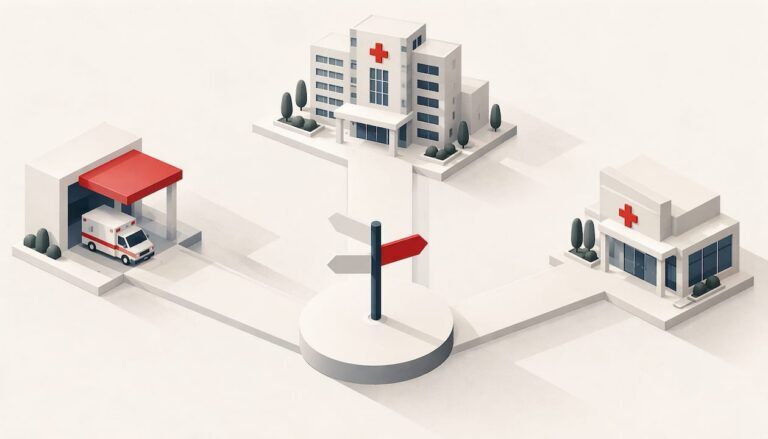
Go to urgent care when a problem needs attention today but is not life-threatening: a sprain, a cut that needs stitches, a fever with flu symptoms, a urinary tract infection, an earache. Go to the emergency room or call 911 when symptoms point to something that could threaten life or lasting function, such as chest pain, trouble breathing or sudden weakness on one side. In Katy, Macie Medical offers urgent care and walk-in visits with a physician-led team, so a same-day problem can be handled by a practice that can also follow up with you afterward.
This guide walks through the decision in plain steps, so you can make a calm choice when you are uncomfortable, worried and short on time.
TL;DR
- Urgent care is for illnesses and injuries that are not life-threatening but should not wait for a routine appointment.
- Call 911 or go to an emergency department for chest pain, trouble breathing, stroke signs, heavy bleeding, a seizure, severe pain or a suspected poisoning.
- Colds that turn into infections, flu, sore throats, UTIs, sprains, minor fractures, rashes and cuts are typical urgent care visits.
- A same-day visit with your own primary care practice is often the best first call, because the doctor can see your history and plan follow-up.
- Call ahead before you go: confirm that the clinic is seeing patients now, what to bring and how your insurance or cash-pay visit will work.
Table of Contents
- The simple test: is this life-threatening?
- Signs you should skip urgent care and go to the ER
- What urgent care can help with
- Urgent care, primary care or ER: how to choose
- Urgent care without an appointment: what to expect
- When urgent care is the wrong stop, even though it is not an emergency
- Should I go if I already feel better?
- What about cost?
- Our perspective on same-day care
- Need to be seen today in Katy?
- FAQ
- Sources
The simple test: is this life-threatening?
Start with one question: could this problem cost me my life, or cause lasting damage, if it waits an hour or two? If the honest answer is yes or maybe, skip urgent care.
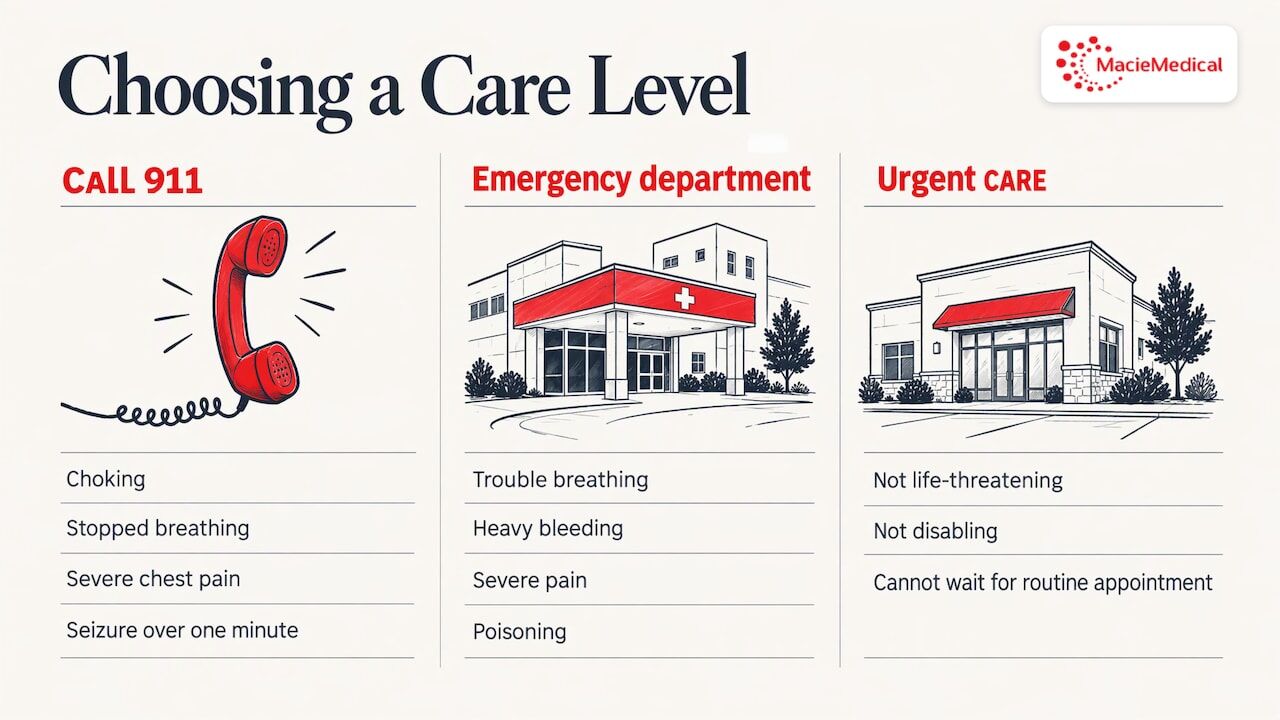
MedlinePlus, the National Library of Medicine’s patient resource, tells adults to call 911 for emergencies such as choking, stopped breathing, severe chest pain, a seizure lasting more than one minute or sudden weakness on one side of the body. It sends people to an emergency department for problems such as trouble breathing, heavy bleeding, severe pain or poisoning. Urgent care fits the space between those and a routine visit: a problem that is not life-threatening or disabling, that worries you, and that you cannot get your regular provider to see soon enough.
If you are unsure, that uncertainty is itself useful information. A symptom that feels frightening and new, especially in the chest, head or breathing, deserves the emergency department rather than a guess.
Signs you should skip urgent care and go to the ER
Emergency departments triage by severity: the sickest patients are seen first. The American College of Emergency Physicians explains this, and it is the reason serious conditions should go straight there instead of making a stop on the way.
MedlinePlus lists these among the problems to take to an emergency department or to 911:
- Trouble breathing, or fainting
- Pain in the arm or jaw, or chest pain
- A sudden, unusual or very bad headache
- Dizziness or weakness that does not go away
- Sudden confusion
- Inhaled smoke or poisonous fumes
- Heavy bleeding or deep wounds
- A possible broken bone with loss of movement, or a bone pushing through the skin
- Serious burns
- Coughing up or vomiting blood
- Severe pain anywhere in the body
- A severe allergic reaction with trouble breathing or swelling
- High fever with a headache and stiff neck
- Poisoning or overdose
The Urgent Care Association, which represents urgent care centers, publishes a red-flags policy for exactly this reason. It names symptoms that should be escalated to a hospital, including chest pain, shortness of breath, major trauma, active bleeding, loss of consciousness, a severe allergic reaction, new localized weakness, severe abdominal pain, a possible overdose, severe testicular pain and seizure. It also names vital-sign red flags for adults, such as a temperature of 102°F or higher, an oxygen saturation under 94%, or a pulse under 50 or over 110.
You do not need a thermometer or pulse oximeter to use that list. It simply shows that even the clinics built for same-day care expect these situations to go to a hospital.
A note on mental health crises
An emergency is not always physical. If you or someone near you is in danger, thinking of suicide or in acute crisis, call 911 for immediate danger or 988, the national Suicide and Crisis Lifeline, for support. This 988 versus 911 guidance explains how to choose between the two.
Severe allergic reactions
Allergist Dr. Aikaterini Anagnostou of the American College of Allergy, Asthma and Immunology notes that guidance changed with the 2023 anaphylaxis parameter. People who use epinephrine can sometimes manage the reaction at home when specific criteria are met, including carrying at least two doses, because symptoms can worsen and a second dose would mean calling 911. Details are on the ACAAI epinephrine page. If you have been prescribed an epinephrine auto-injector, follow the plan your allergist gave you, and call 911 if symptoms are severe or return.
What urgent care can help with
Urgent care is meant for problems that came on recently, are bothersome or painful, and are not threatening your life. Typical visits include:
- Colds, flu and sore throats: fever, cough, congestion, ear pain, sinus pressure and throat pain that is getting worse instead of better.
- Minor injuries: sprains, strains, cuts that may need stitches, minor burns and bruising after a fall.
- Urinary symptoms: burning, urgency or frequent urination that suggests a urinary tract infection.
- Skin problems: rashes, insect bites, minor infections and abscesses.
- Stomach upset: vomiting or diarrhea that is making it hard to keep fluids down, without severe pain.
- Mild allergic reactions and flare-ups of seasonal allergies.
- Minor eye irritation, including pink eye.
Which of these a given clinic handles depends on its equipment and staff, so check before you go. Macie Medical lists the conditions we treat on our Katy urgent care page.
Worked example: the weekend sprain
Say you step off a curb on Saturday morning and your ankle swells. You can still bear some weight, there is no bone visible, and the foot is not numb or discolored. This is a classic urgent care visit: a clinician can examine the ankle, decide whether imaging is needed, and give you a plan for support and recovery. If instead the foot looks deformed, you cannot move it at all or the skin is broken over a bone, that points to the emergency department.
Worked example: the sore throat that is not getting better
A scratchy throat on Monday is a home-care problem. By Thursday, with fever, swollen glands and pain when swallowing, it is time to be seen. Trouble breathing or being unable to swallow your own saliva is different: that is an emergency.
Urgent care, primary care or ER: how to choose
A short comparison helps when you are deciding under pressure.
| Situation | Best first stop |
|---|---|
| Chest pain, stroke signs, severe bleeding, trouble breathing | 911 or the emergency department |
| Sprain, minor cut, flu symptoms, UTI, rash, earache | Urgent care or a same-day sick visit |
| Ongoing condition (blood pressure, diabetes, thyroid) that feels off | Your primary care practice, same day if possible |
| Refills, yearly screening, new symptoms that are mild and stable | Primary care appointment |
| Mild illness you can describe to a doctor and do not need examined in person | Telehealth visit |
We go deeper in our guides on the difference between urgent care and the emergency room, the difference between urgent care and primary care and who you see at an urgent care visit.
Why your own practice is often the smart first call
If you already have a primary care doctor, call there first for anything that is urgent but not an emergency. A doctor who knows your medications, your blood pressure history and your past lab results can make a better decision about a new symptom than a clinic seeing you for the first time. It also means the visit does not end at the door: your plan, prescriptions and follow-up stay in one record.
That is why we describe primary care as a home base. When your health has one, a sudden problem becomes a phone call, not a search.
Urgent care without an appointment: what to expect
One reason people choose urgent care is that you can usually be seen without booking weeks ahead. Walk-in care is common, but every clinic runs differently, so a quick call saves a trip. Before you leave home:
- Call or check online. Ask whether the clinic is seeing patients now, whether they treat your symptom and about how long the wait is.
- Gather your information. Bring photo ID, your insurance card if you have one, a list of medications and allergies, and the name of your primary care doctor.
- Write down your timeline. When did symptoms start, what has made them better or worse, and what have you already taken?
- Ask about payment. If you are insured, ask whether the clinic is in your plan’s network. If you are self-pay, ask how pricing works. Macie Medical’s cash-pay page explains our self-pay visits.
- Plan for a transfer. If the clinician finds something serious, you may be sent to a hospital, so do not go alone if you feel faint or unwell.
If you are not sure the trip is necessary, a virtual sick visit may be enough. We offer telehealth appointments for patients anywhere in Texas, which is useful for things like cold symptoms, rashes or medication questions, when you can describe the problem and do not need to be physically examined.
When urgent care is the wrong stop, even though it is not an emergency
Some situations are not emergencies and not really urgent-care problems either. They are better handled by a doctor who follows you over time:
- Chronic conditions. Blood pressure that has been creeping up, blood sugar that is hard to manage or thyroid symptoms need a plan, not a single visit. Our chronic care management is built for that kind of ongoing partnership.
- Women’s health. Well-woman exams, Pap smears, birth control and menopause care are best handled in a regular relationship. See our women’s health services.
- Preventive care. Yearly screenings and a physical exam catch problems before they become urgent.
- Weight management. Our medical weight loss program is physician-supervised and led by a board-certified obesity medicine doctor.
If you do not have a primary care doctor, an urgent visit is a good moment to find one. Our guide to choosing an adult primary care clinic can help.
Should I go if I already feel better?
It depends on why you were going. If a fever broke, a cough eased and you are eating and drinking normally, you may not need a visit, but a call to your doctor is reasonable if you had symptoms such as chest tightness or a high fever. If you hurt a joint and the swelling went down but it still gives way or hurts to bear weight, get it checked. A symptom that improves and then returns, or improves with new symptoms, is worth a call.
What about cost?
Urgent care visits generally cost less than an emergency department visit for the same minor problem, though what you pay depends on your plan, your deductible and the services you need. We explain the differences in our guide to the cost difference between urgent care and the emergency room. The takeaway: using the right level of care protects your health and keeps you from paying for a level you did not need.
Our perspective on same-day care
We see urgent care as one part of a larger relationship, not a separate world. When something goes wrong on a Tuesday afternoon, you want to be seen quickly, but you also want someone who listens, explains and then follows up.
At Macie Medical, Dr. Judith Aniekwena is board-certified in internal medicine and obesity medicine, and our practice was built on the idea that you will be heard here. That means same-day sick visits, urgent care and walk-in services alongside primary care, women’s health, chronic care and weight management, so the doctor who treats your ear infection can also help you manage your blood pressure.
Our goal is that every patient leaves understanding their plan: what we found, what to do next and when to come back. If your symptoms point to an emergency, we want you at the hospital without delay, and we would rather you go than wait.
Macie Medical
Need to be seen today in Katy?
Macie Medical serves patients from Katy, Cypress, Richmond and Memorial City with urgent care and walk-in visits, same-day sick visits and telehealth across Texas. If you are closer to Richmond, our Richmond walk-in clinic page has the details. Starting November 16, 2026, we welcome patients at our new, larger office at 633 E Fernhurst Dr, Suite 205, Katy, TX 77450. Call or book online to schedule your visit, and see all our services.
For more reading, our urgent care insights and tips collect practical guidance in one place.
FAQ
What time of day is urgent care busiest?
Clinics are often busiest after typical work and school hours, on weekends and on Mondays, when people who put off care over the weekend arrive. Patterns vary by clinic, so call ahead and ask about the current wait. Going earlier in the day, when you can, often means a shorter visit.
What is considered urgent but not an emergency?
An urgent problem is one that should be treated within about a day but does not threaten your life or limbs. Examples are a sprained ankle, a fever with flu symptoms, a UTI, a cut that needs stitches or a worsening sore throat. If symptoms include trouble breathing, chest pain, heavy bleeding or sudden weakness, treat it as an emergency instead.
Can I go to urgent care without an appointment?
Urgent care is designed for walk-in visits, and many clinics do not require an appointment. Hours and wait times differ, so call first, bring your ID, insurance card and medication list, and ask whether the clinic treats your symptom. At Macie Medical you can call or book online for a same-day visit.
Should I go to urgent care or my primary care doctor?
For a new, non-emergency problem that needs attention today, either can work, but your primary care practice knows your history and can arrange follow-up. If your own doctor cannot see you in time, urgent care is the right alternative. For chronic conditions, refills and preventive screening, schedule a regular primary care visit.
Can urgent care help with a medical emergency?
No. For chest pain, stroke symptoms, severe bleeding, trouble breathing, a seizure or a suspected overdose, call 911 or go straight to an emergency department. Going to urgent care first only delays the care you need.
Sources
- When to use the emergency room – adult, MedlinePlus
- Red Flags Identification and Intervention Policy for Urgent Care Centers, Urgent Care Association
- Emergency Care, Urgent Care: What’s the Difference?, American College of Emergency Physicians
- If I use epinephrine for an allergic reaction, do I have to call 911?, ACAAI
- 988 versus 911 guidance