
Heavy periods are one of the most treatable reasons women feel worn out, so you do not have to plan your month around them. The most effective path starts with a visit to a physician who listens, looks for the cause, and matches a treatment to your age, your health and your plans. At Macie Medical in Katy, women’s health care includes well-woman exams, birth control and menopause care, and you can be seen in person or by telehealth anywhere in Texas.
TL;DR
- Bleeding is considered heavy when it lasts more than 7 days, needs a new pad or tampon in under 2 hours, or comes with large clots, according to the CDC.
- Treatment depends on the cause. Common options include birth control pills, a hormonal IUD, tranexamic acid, ibuprofen-type medicines and iron when levels are low.
- A Cochrane review found the levonorgestrel IUD gives a large reduction in blood loss, while ibuprofen-type medicines reduce it only slightly.
- Soaking through a pad or tampon every hour or two, dizziness, chest pain or shortness of breath mean you should call a doctor promptly.
Table of Contents
- What counts as a heavy period
- Why periods become heavy
- How a doctor finds the cause
- Heavy periods treatment options
- What you can do at home
- When to call a doctor right away
- Why one steady doctor makes a difference
- Our perspective on heavy periods
- Book a visit in Katy
- FAQ
- Sources
What counts as a heavy period
Most women have no benchmark for their own flow, so it is hard to know whether yours is “normal.” The CDC describes heavy menstrual bleeding as bleeding that lasts more than 7 days, needs a new tampon or pad after less than 2 hours, or includes large clots. Signs you may recognize:
- soaking a pad or tampon every hour for several hours in a row
- doubling up on products, such as a tampon plus a pad
- waking at night to change protection
- clots the size of a quarter or larger
- constant lower-abdominal pain or severe cramps
- tiredness or shortness of breath, which can point to anemia (a low red blood cell count)
The same CDC page notes that heavy bleeding can limit daily activities and can lead to iron-deficiency anemia. The U.S. Office on Women’s Health reports that heavy periods affect about one in five American women each year, so you are far from alone. If you are canceling plans, avoiding exercise or planning your work around your cycle, that is reason enough to book a visit.
Why periods become heavy
Heavy bleeding is a symptom, not a diagnosis, and treatment works best when it targets the cause. The American College of Obstetricians and Gynecologists (ACOG) lists several possible causes:
- Fibroids and polyps. These are growths in or on the uterus. Our partners’ uterine fibroids guide explains how they develop and how they are evaluated.
- Adenomyosis and endometriosis. Both involve uterine-lining tissue growing where it should not.
- Irregular ovulation. This is common during puberty and perimenopause, and with polycystic ovary syndrome (PCOS) or an underactive thyroid.
- Bleeding disorders. Womenshealth.gov notes that up to one in five white women with heavy periods has one, and about one in 20 African-American women.
- Medicines. Blood thinners and aspirin can increase bleeding, and a copper IUD can make periods heavier.
- Pregnancy-related causes. Miscarriage and ectopic pregnancy can look like a heavy period. An ectopic pregnancy is a medical emergency.
Womenshealth.gov also lists extra estrogen related to obesity among the causes. If you are in your 40s, our guides to perimenopause and hormonal imbalance in women explain why cycles often turn unpredictable, and our overview of PCOS covers another frequent culprit.
How a doctor finds the cause
A good evaluation starts with your story. ACOG describes a detailed history and cycle tracking, a pelvic exam, and pregnancy and sexually transmitted infection tests. Depending on your age and symptoms, the next steps may include an ultrasound, hysteroscopy (a thin camera passed into the uterus), an endometrial biopsy or MRI. Mayo Clinic adds blood tests for anemia, thyroid function and clotting problems.
You can make that first visit far more useful with a few days of preparation:
- Note the first day of your last three periods and how many days each lasted.
- Count how many pads or tampons you use on your heaviest day, and how often you change them overnight.
- Write down clot sizes, pain, dizziness and fatigue.
- List every medicine and supplement you take, including aspirin and blood thinners.
- Bring questions about future pregnancy, because that changes which treatments fit.
At Macie Medical we offer on-site lab services, so bloodwork does not have to turn into a separate errand.
Heavy periods treatment options
The CDC’s list of treatments gives a good map: iron supplements for anemia, ibuprofen to reduce pain and bleeding, birth control pills, drug-releasing intrauterine contraception, hormone therapy, desmopressin nasal spray for von Willebrand disease and mild hemophilia, and antifibrinolytics, which stop clots from breaking down. ACOG notes medications are often tried first. Here is how the main options compare.
| Option | How it helps | Worth knowing |
|---|---|---|
| Hormonal birth control (pills and others) | Can lighten, regularize or stop bleeding | Also provides contraception |
| Levonorgestrel IUD (hormone-releasing) | Large reduction in blood loss in a Cochrane review | Placed in the office; also contraception |
| Tranexamic acid | Prescription tablet taken at the start of each period | Works on clotting, not hormones |
| NSAIDs such as ibuprofen | Help control bleeding and cramps | Only a slight reduction in blood loss |
| Iron | Treats or prevents low iron and anemia | Does not by itself lighten flow |
| Clotting medications | For women with bleeding disorders | Chosen after testing |
| Hormone therapy | May help perimenopausal heavy bleeding | Carries increased risks of heart attack, stroke and cancer, per ACOG |
Medicines to reduce the flow
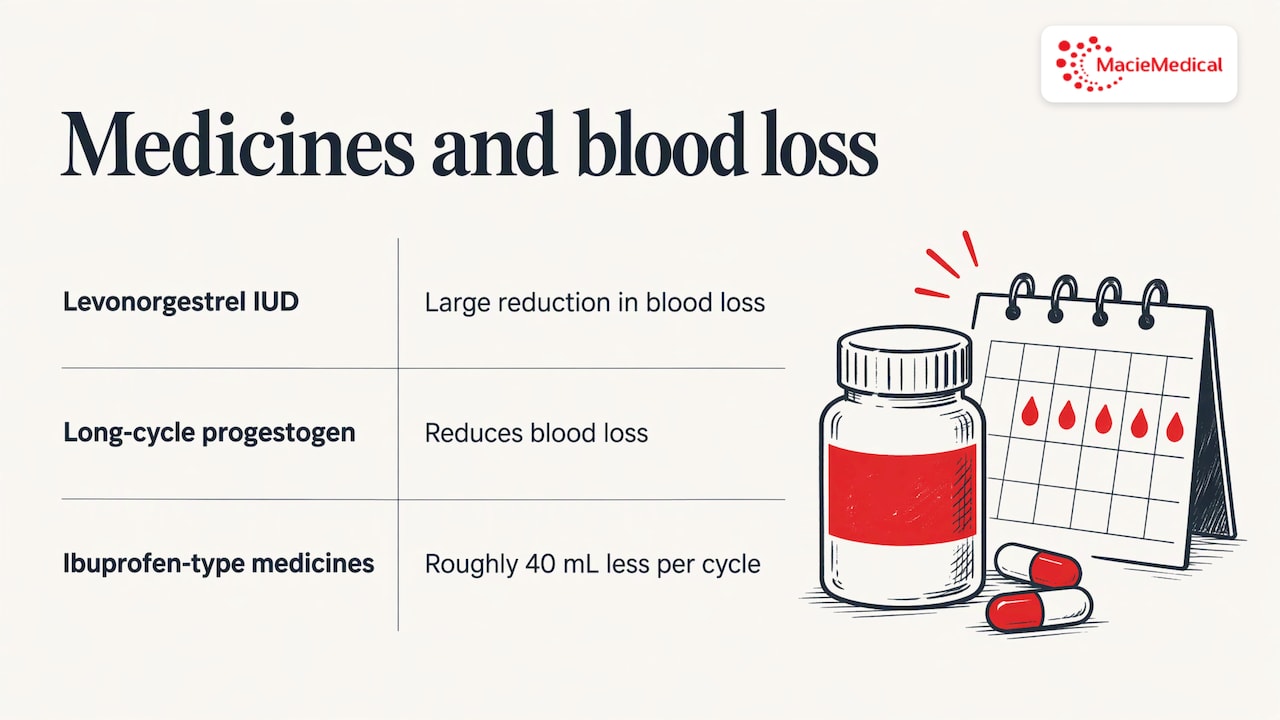
A 2022 Cochrane systematic review concluded that the levonorgestrel IUD produces a large reduction in menstrual blood loss, based on moderate-certainty evidence. It also found that long-cycle progestogen reduces blood loss. Ibuprofen-type medicines lowered it by roughly 40 mL per cycle, a modest effect that still helps many women with cramps.
That is why we often talk about the IUD, hormonal birth control and tranexamic acid together: they act in different ways, and the right one depends on whether you want contraception, whether you hope to conceive and what else is going on with your health. If you already take birth control and bleed between periods, our guide to birth control breakthrough bleeding explains what is typical and what to bring up.
Treating the cause
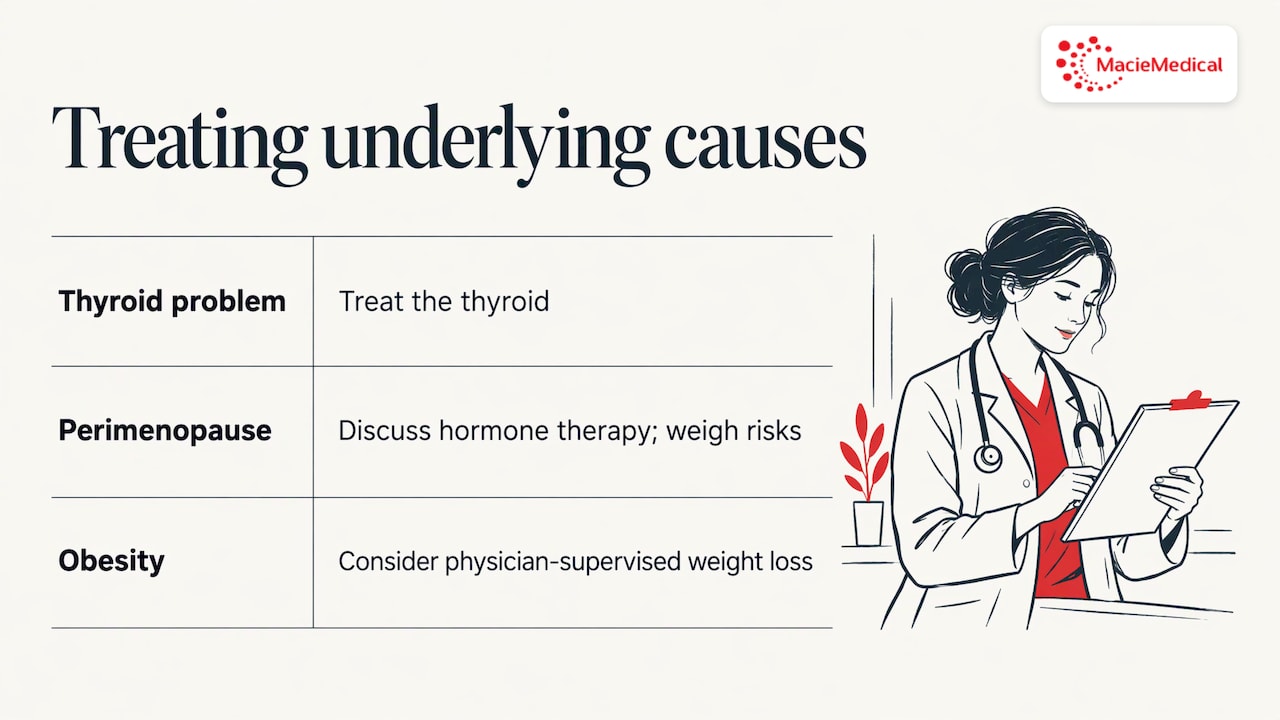
When a thyroid problem drives the bleeding, treating the thyroid can help. When perimenopause is the trigger, a conversation about hormone therapy and its safe use may fit, keeping in mind the cardiovascular and cancer risks ACOG lists. Weight can matter too: obesity-related estrogen is one recognized contributor, and physician-supervised medical weight loss is part of our care for patients who want support there.
Newer prescription options for fibroids
For premenopausal women whose heavy bleeding comes from fibroids, there are combination tablets approved for this specific purpose. The Oriahnn label (effective December 19, 2025) and the Myfembree label (September 4, 2025) both limit use to 24 months because of the risk of bone loss that may not be reversible. These are decisions to make with a physician who knows your full history.
What you can do at home
Home care supports treatment but does not replace finding the cause. The most useful step is protecting your iron. A peer-reviewed review in the National Library of Medicine’s PMC archive describes a two-way relationship: heavy periods deplete iron, and chronic iron deficiency can in turn make bleeding worse. It recommends iron-rich foods when heavy loss recurs monthly and notes that iron supplements may be started when levels are low, even before anemia develops.
That is a good reason to have your levels checked rather than guess. Practical habits that help:
- Track your cycle in an app or on paper so you can show patterns.
- Eat iron-rich foods such as lean meat, beans, lentils and leafy greens.
- Keep spare supplies and a change of clothes where you need them, so a surprise flow does not derail your day.
- Ask your clinician before taking ibuprofen or aspirin regularly, especially if you are on a blood thinner.
- Rest when you feel weak or lightheaded.
Supplements marketed for heavy periods are not a substitute for an exam, because the right treatment depends on what is causing the bleeding.
When to call a doctor right away
Some patterns should not wait for your annual visit. Womenshealth.gov advises calling your doctor if:
- your period lasts longer than eight days
- you bleed through one or more pads or tampons every one to two hours
- you pass clots larger than a quarter
- you feel dizzy, lightheaded, weak or very tired, or have chest pain or trouble breathing during or after your period, which can signal anemia
If you might be pregnant and you have heavy bleeding with sharp pain, treat it as urgent, because miscarriage and ectopic pregnancy can cause both. Chest pain, trouble breathing or fainting call for 911 or the nearest emergency room. For heavy bleeding that is worrying but stable, a same-day sick visit is often the fastest route to answers, and we hold same-day appointments for exactly that kind of concern.
Why one steady doctor makes a difference
Heavy periods rarely have a single, one-visit fix. You may need a pelvic exam, labs, a trial of one medicine, a follow-up to see whether it worked and a plan that changes as you move toward perimenopause. When one physician follows the whole thread, nothing gets repeated, and you are not retelling your story at every appointment. That continuity is the reason many women choose a primary care home base for their women’s health instead of treating each symptom as a separate problem. Our guide on choosing an adult primary care clinic explains what to look for.
Our perspective on heavy periods
Too many women are told that heavy periods are just something to live with. We do not see it that way. Heavy bleeding is a medical symptom with causes that can be found and treatments that can be matched to your life.
At Macie Medical, our promise is that you will be heard. Dr. Judith Aniekwena is board-certified in internal medicine and obesity medicine, and she looks at the whole person: your cycle, your iron, your thyroid, your weight, your medications and your plans for the future. That wider view matters, because heavy periods often connect to other parts of your health.
We believe in unhurried visits where you leave understanding your plan. Whether you are in your twenties and want a method that fits your life, or in your forties and noticing that your cycle has changed, we welcome the conversation. You do not have to wait until it becomes an emergency.
Macie Medical
Book a visit in Katy
Macie Medical is a primary care practice serving Katy, Cypress, Richmond and Memorial City, with telehealth visits for patients anywhere in Texas. Our women’s health services include well-woman exams, Pap smears, birth control and menopause care, and we offer same-day sick visits when you need to be seen quickly. Our office is at 633 E Fernhurst Dr, Suite 205, Katy, TX 77450. You can book online or look at our cash pay options if you are paying without insurance.
Bring your cycle notes and your questions, and we will take it from there.
FAQ
How can I reduce heavy periods?
Start by finding out why they are heavy, since the cause guides the treatment. Medicines such as hormonal birth control, a hormone-releasing IUD, tranexamic acid or ibuprofen-type medicines are common first steps. Checking your iron and eating iron-rich foods supports recovery alongside treatment.
Is it normal to pass blood clots during my period?
Small clots can happen, but clots larger than a quarter are listed by the CDC and womenshealth.gov as a sign of heavy bleeding. If you regularly pass clots that size, or you also feel dizzy or very tired, call your doctor.
Can heavy periods cause anemia?
Yes. Ongoing blood loss can deplete iron and lead to iron-deficiency anemia, with fatigue, weakness and shortness of breath. A simple blood test can show your iron level, and iron supplements may be started when levels are low.
Should I go to the ER for a heavy period?
Go to the emergency room if you have chest pain, trouble breathing, fainting, or heavy bleeding with severe pain, especially if you could be pregnant. For heavy bleeding that is concerning but not an emergency, call your doctor the same day, particularly if you are soaking a pad or tampon every one to two hours.
Sources
- About Heavy Menstrual Bleeding, CDC
- Heavy Menstrual Bleeding, ACOG
- Period problems, Office on Women’s Health
- Interventions for the treatment of heavy menstrual bleeding, Cochrane review, 2022
- Menorrhagia: A synopsis of management, PMC
- Oriahnn prescribing information
- Myfembree prescribing information