

The right perimenopause doctor is a physician who has time to listen, rules out other causes of your symptoms, and walks you through treatment options based on your age, history and preferences. For many women in Katy, Cypress, Richmond and Memorial City, that is a primary care physician trained in internal medicine who knows your whole health picture. At Macie Medical, women’s health care includes menopause care, with in-person visits and telehealth appointments for patients anywhere in Texas.
This guide explains what a perimenopause doctor does, when to make the appointment, what happens at the visit, and which treatments are worth discussing. It reflects U.S. medical guidance published through October 2026.
TL;DR
- Perimenopause is the transition before your last period. A doctor confirms it mainly by listening to your symptoms and excluding other causes, not by a single lab test.
- Book a visit if your periods are very close together, very heavy, last more than a week, or you bleed after sex or between periods.
- Hormone therapy is now backed by new 2026 guidance as a first-line option for hot flashes and night sweats. Nonhormonal medicines and therapies are also available.
- Your decision should be individual: your age, history and risks matter more than any one-size rule.
- Bring a symptom log to your first visit. It makes the conversation faster and clearer.
Table of Contents
- What a perimenopause doctor actually does
- Which kind of doctor should you see?
- When to make the appointment
- What happens at a perimenopause visit
- How to prepare so you get more from the visit
- Treatment options your doctor can discuss
- Our perspective
- Booking perimenopause care at Macie Medical
- FAQ
- Sources
What a perimenopause doctor actually does
Perimenopause is the stretch of years when your hormones begin to shift and your cycle changes, before you reach menopause. Menopause itself is confirmed after 12 months without a menstrual period, and the average age of the last period is 51, according to the American College of Obstetricians and Gynecologists (ACOG). Everything before that point is the transition.
A good perimenopause doctor does four things:
- Listens to the full story of your symptoms, including sleep, mood, bleeding patterns and how they affect your work and family life.
- Rules out other causes that can look like perimenopause.
- Explains your options in plain language, with benefits and risks.
- Follows up, adjusts the plan and keeps screening you for the rest of your health.
That last point matters. Perimenopause rarely arrives alone. Blood pressure, cholesterol, thyroid function, sleep, weight and bone health are all part of the same conversation, which is why continuity with one physician helps.
Which kind of doctor should you see?
You have more than one good option. Gynecologists and physicians trained in internal medicine both treat perimenopause, and ACOG advises seeing a women’s health physician regularly during this time. In a piece on mood changes during perimenopause, ACOG’s Dr. Nazanin Silver explains that the physician can work out whether symptoms point to a mental health condition and refer you to a psychiatrist when that is needed. Antidepressants and estrogen therapy are among the options she names.
When you choose, look for these qualities:
- Time. Perimenopause is a conversation, not a five-minute prescription.
- Whole-person care. Your doctor should consider your heart, thyroid, bones and mental health alongside your hormones.
- Willingness to individualize. Treatment should fit your risks and preferences.
- Easy access. Symptoms change, so follow-up should be simple. Telehealth helps here.
- A long-term relationship. The same doctor who knows your baseline can spot what is new.
Dr. Judith Aniekwena, MD, who founded Macie Medical, is board certified in internal medicine and obesity medicine and was named a Houstonia Top Doctor in Primary Care for 2026. Internal medicine training is built around adult health across systems, which suits a transition that touches sleep, mood, metabolism and heart health at the same time. If you want a longer-term home base for care, our primary care services cover preventive screenings, chronic conditions and women’s health under one roof.
When to make the appointment
You do not need to wait until symptoms are severe. Many women book when sleep, mood or cycles start to feel off. But some signs mean you should be seen promptly. The National Institutes of Health says to see a provider if your periods:
- come very close together,
- involve heavy bleeding,
- include spotting after sex or between periods,
- last more than a week, or
- return after more than a year without a period.
Those patterns are listed on the NIH menopause page. Bleeding that returns after a full year without a period always deserves a prompt visit, because it needs to be evaluated rather than assumed to be hormonal.
For a deeper look at what changes in your 40s, see our guide to perimenopause symptoms in your 40s, and if you are unsure where you are in the transition, perimenopause vs menopause explains the difference.
Common symptoms worth tracking
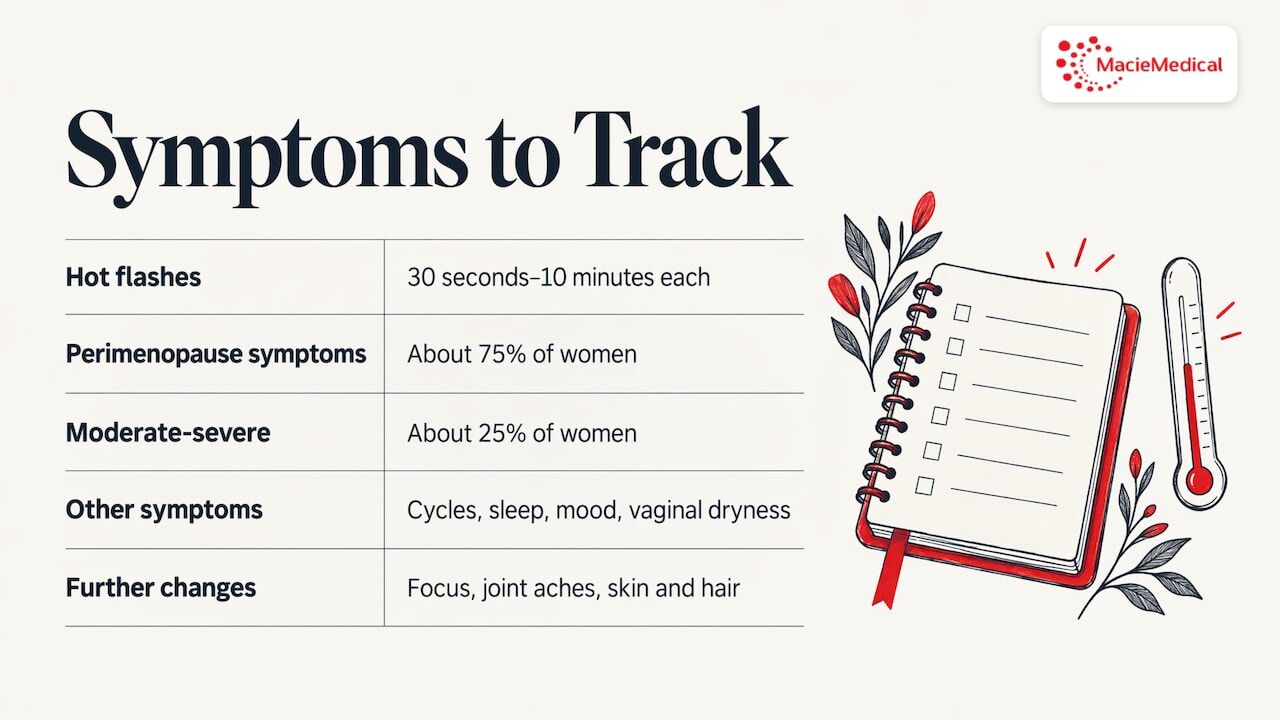
Hot flashes and night sweats are the best-known symptoms. NIH notes that most hot flashes last between 30 seconds and 10 minutes. Other changes include irregular cycles, sleep disruption, mood shifts, vaginal dryness, trouble concentrating, joint aches and changes in skin and hair. A 2023 review in the journal literature estimates that about 75% of women have symptoms during perimenopause and after menopause, and about 25% have symptoms in the moderate-to-severe range. You are far from alone, and you do not have to simply wait it out.
What happens at a perimenopause visit
A conversation first
Expect questions about your cycle, such as how regular it is, how heavy and when your last period was. You will also be asked about hot flashes, sleep, mood, sexual comfort, urinary symptoms and your family history. Your doctor will also review medications, because some can cause symptoms that resemble perimenopause.
Ruling out other causes
Perimenopause is what clinicians call a diagnosis of exclusion. ACOG’s Dr. Esther Eisenberg explains that, especially for a woman in her 40s, clinicians first consider thyroid disorders, high prolactin, polyps, fibroids, adenomyosis and infection, using a pelvic exam, blood tests and ultrasound as needed. This step protects you. Irregular periods deserve a real explanation before anyone labels them perimenopause.
This is where having a practice with on-site lab services is convenient: the blood work that rules out thyroid problems can be part of the same visit plan.
Do you need a hormone test?
Usually not to confirm perimenopause. A peer-reviewed 2024 review states that formal laboratory testing is not recommended to determine menopausal status for most patients, once other causes of missed periods such as pregnancy, breastfeeding and medication effects have been excluded. Hormone levels swing from day to day during the transition, so a single number can mislead. Your symptoms and history carry the diagnosis. If your doctor does order a panel for a specific reason, it helps to understand what hormone panel testing covers.
How to prepare so you get more from the visit
A little preparation turns a general chat into a clear plan.
- Track your cycle for two or three months. Note start dates, flow and spotting.
- Log symptoms. ACOG’s Menopause Symptom Tracker is a checklist covering bleeding changes, hot flashes, mood, vaginal and sexual health, sleep, urinary symptoms, memory, skin and hair. It also records your treatment preferences, including whether you are interested in hormone therapy or cannot take it for a medical reason.
- List your medications and supplements.
- Write down family history of breast cancer, blood clots, heart disease and osteoporosis.
- Note your goals. Better sleep? Fewer hot flashes? A steadier mood? Say what matters most.
- Bring your questions. Our women’s health checklist and women’s preventive exam after 40 guide can help you plan what to ask.
Bone density is a good question to raise too, since estrogen changes affect bones. Reading about menopause and bone loss can help you decide what to discuss with your doctor.
Treatment options your doctor can discuss
The guidance here moved quickly in 2026, so it is worth knowing what is current. Your treatment is always a shared decision, not a one-size rule.
Hormone therapy
In October 2026, the American College of Physicians published a guideline recommending estrogen with a progestogen, or estrogen alone if you have no uterus, as first-line treatment for hot flashes and night sweats. The 2026 VA/DoD guideline also recommends systemic estradiol plus progesterone for vasomotor symptoms in women with a uterus.
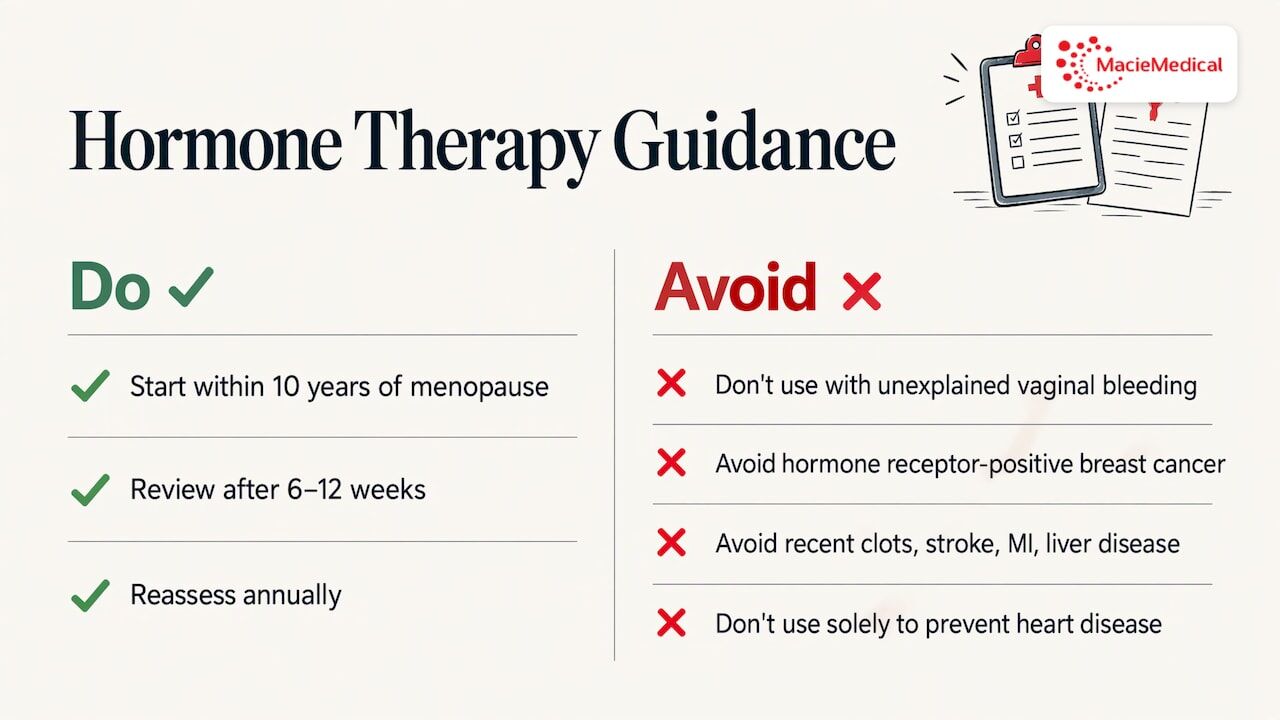
Timing matters. ACOG’s October 2026 guidance recommends starting hormone therapy before age 60 or within 10 years of menopause in people without contraindications, weighing age, medical history and baseline cardiovascular, breast cancer and blood clot risks. The Office on Women’s Health also says benefits are more likely to outweigh risks when therapy starts before 60 or within 10 years of menopause. It reports that in February 2026 the FDA approved labeling changes for six hormone products, removing heart disease, breast cancer and probable dementia statements from the boxed warning. The endometrial cancer warning remains on whole-body estrogen-only products.
A 2023 review notes that menopausal hormone therapy is the most effective treatment for these symptoms and should be reviewed after 6 to 12 weeks, then reassessed annually. Our guide to perimenopause and HRT walks through what that looks like.
Who should avoid it. The Office on Women’s Health lists situations where hormone therapy is usually not recommended: unexplained vaginal bleeding, hormone receptor-positive breast cancer, a current or recent blood clot, stroke or heart attack, and liver disease. It also should not be taken solely to prevent heart disease. This is exactly why a physician reviews your history first.
Hormonal birth control
If you still need contraception, one option can do double duty. Hormonal contraceptives are FDA-approved up to menopause, and a review in the medical literature suggests 20 to 30 microgram ethinyl estradiol formulations as a starting point, with an IUD as an alternative for women at high cardiovascular risk. Birth control is part of our women’s health services, so this can be handled in the same visit.
Nonhormonal options
If hormones are not right for you, or you prefer another route, there are choices. ACOG’s October 2026 update adds the newer medicines fezolinetant and elinzanetant, SSRIs and SNRIs, plus approaches such as cognitive behavioral therapy, mindfulness, exercise, clinical hypnosis and acupuncture. ACOG also states that evidence does not support phytoestrogens or herbal supplements for menopausal symptoms, so ask your doctor before starting one, especially alongside other medicines.
The ACP guideline places SNRIs as second-line and SSRIs, gabapentin or the newer neurokinin receptor antagonists as third-line when estrogen is not an option. The VA/DoD work group found insufficient evidence to favor the newer drugs over hormone therapy, so they are good options but not a replacement for the conversation.
One treatment for several problems
A sensible plan avoids stacking medications. A well-known review of perimenopause care favors a single treatment that addresses several issues at once, for example gabapentin reducing night sweats while improving sleep, so a separate sleep medicine can be stopped. A physician who sees your whole medication list is well placed to do this.
Weight and metabolism
Many women notice weight changes during this stage. Because Dr. Aniekwena is also board certified in obesity medicine, our medical weight loss program can sit alongside your perimenopause care. It is physician supervised and includes GLP-1 medications such as tirzepatide when appropriate.
Our perspective
Women often tell us they came in after months of wondering whether what they felt was “normal.” Our answer starts with listening. Macie means “gift,” and we try to give each patient time, attention and respect.
We believe perimenopause is best handled by a doctor who knows you, not only your symptoms. The same visit can include your blood pressure, thyroid, weight, sleep and screenings, and the plan fits the life you actually live.
Our approach is evidence-based and personalized. We go through your history, discuss hormone and nonhormonal options, and make sure you leave understanding your plan. Telehealth follow-ups help you adjust treatment without rearranging your week.
Macie Medical
Booking perimenopause care at Macie Medical
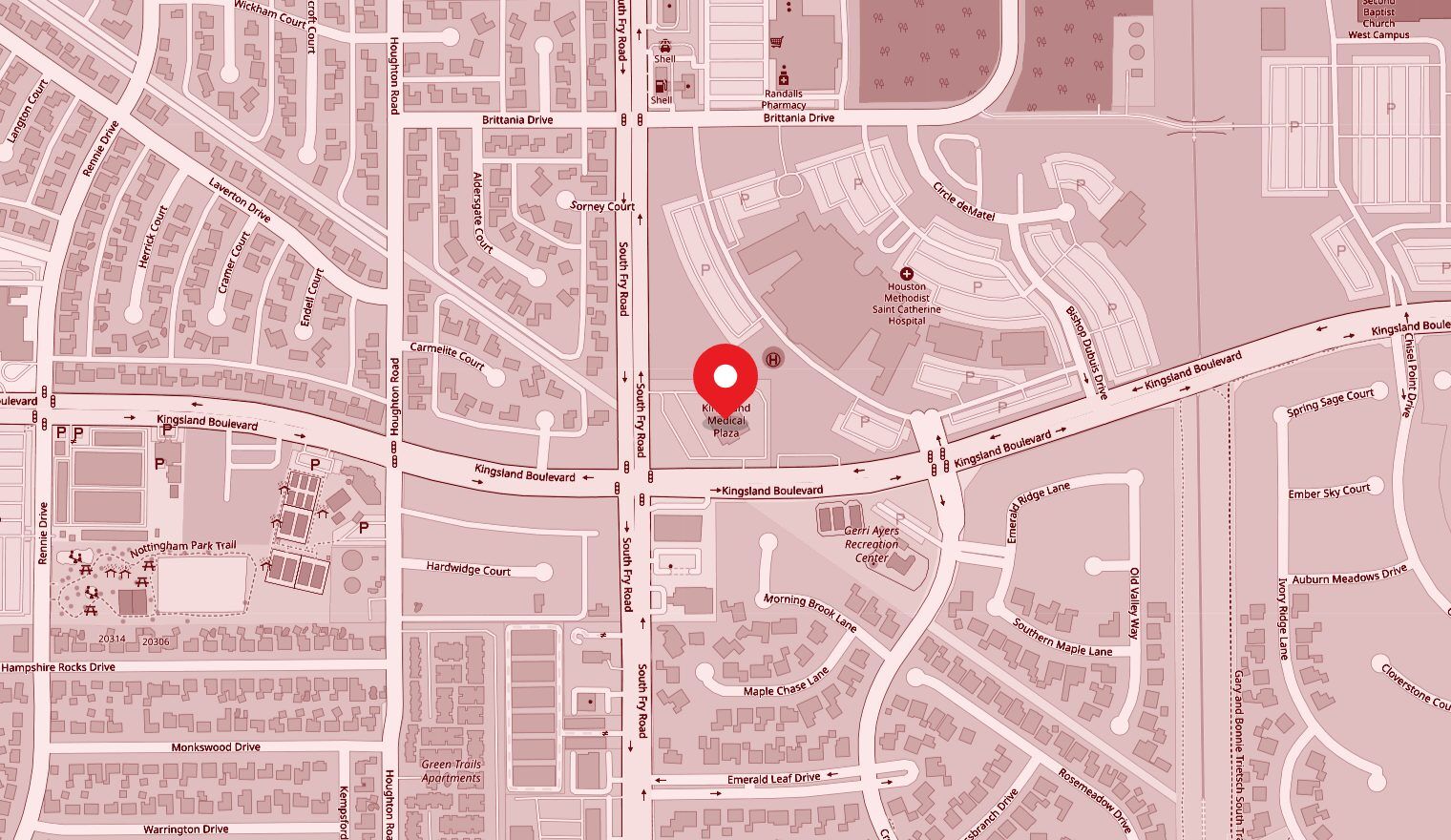
If you are ready for a doctor who will hear you out, Macie Medical offers women’s health care, preventive exams and menopause care for patients from Katy, Cypress, Richmond and Memorial City. You can be seen in person or by telehealth from anywhere in Texas. Our new, larger office at 633 E Fernhurst Dr, Suite 205, Katy, TX 77450 opens to patients on November 16, 2026.

See our services, review cash-pay options, or go to maciemedical.com to book online.
FAQ
What does “premenopausal” mean?
Premenopausal generally describes the years when you still have regular periods and no menopausal changes yet. Perimenopause begins when your cycle and symptoms start to change. Menopause is confirmed after 12 months without a period.
Do I need blood tests to know if I am in perimenopause?
Usually not to confirm it. Current review literature says formal testing is not recommended for most patients once other causes are excluded. Your doctor may still order blood work, such as thyroid tests, to rule out other explanations.
Is hormone therapy safe for me?
It depends on your age, history and risks. Guidance from ACOG and the Office on Women’s Health says benefits are more likely to outweigh risks when you start before 60 or within 10 years of menopause. It is usually not recommended with unexplained vaginal bleeding, hormone receptor-positive breast cancer, a recent blood clot, stroke or heart attack, or liver disease, so your physician should review your history first.
Can I be seen by telehealth for perimenopause?
Yes. Macie Medical offers telehealth appointments for patients anywhere in Texas, which is useful for follow-ups when you are adjusting a treatment. You can also come in person at our Katy office.
Sources
- NIH Office on Women’s Health: Menopause
- ACOG: Mood Changes During Perimenopause Are Real
- ACOG: My Periods Have Changed. Is Menopause Around the Corner?
- ACOG: Menopause Symptom Tracker
- Menopause Decoded: What’s Happening and How to Manage It (PMC)
- Management of menopause (PMC, 2023)
- Management of the Perimenopause (PMC)
- Office on Women’s Health: Hormone therapy safety
- ACOG: Expands Recommendations for Management of Menopause Symptoms
- ACP: Hormonal therapy as a first-line treatment for menopausal vasomotor symptoms
- VA/DoD Menopause Clinical Practice Guideline, 2026
- Hormone panel testing overview
- Menopause bone loss