
Breakthrough bleeding is light bleeding or spotting when you are not expecting a period, and it is common with hormonal birth control. ACOG says it rarely signals a health problem and does not mean your birth control has stopped working. Most of the time it settles as your body adjusts. When it does not, a visit with a primary care physician who handles women’s health can find the cause and give you a clearer path forward. At Macie Medical in Katy, contraception and well-woman care are part of what we do.
TL;DR
- Spotting between periods is one of the most common side effects of hormonal birth control, especially in the first few months.
- Missed or late pills, smoking, low-dose formulas, continuous regimens, emergency contraception and some infections can all contribute.
- Bleeding often decreases with continued use. After an IUD placement it commonly improves within 2 to 6 months.
- Bleeding that is heavy, lasts more than seven days, follows sex, comes with pain, or does not settle deserves a visit.
- Mood changes are a separate, real concern worth raising with your clinician.
Table of Contents
- What breakthrough bleeding is, and what it is not
- Why it happens
- How long breakthrough bleeding usually lasts
- What you can do at home
- Medical options a clinician may discuss
- When to get checked
- Birth control and mood changes
- Our perspective
- Seeing us for birth control concerns
- What to bring to your appointment
- FAQ
- Sources
What breakthrough bleeding is, and what it is not
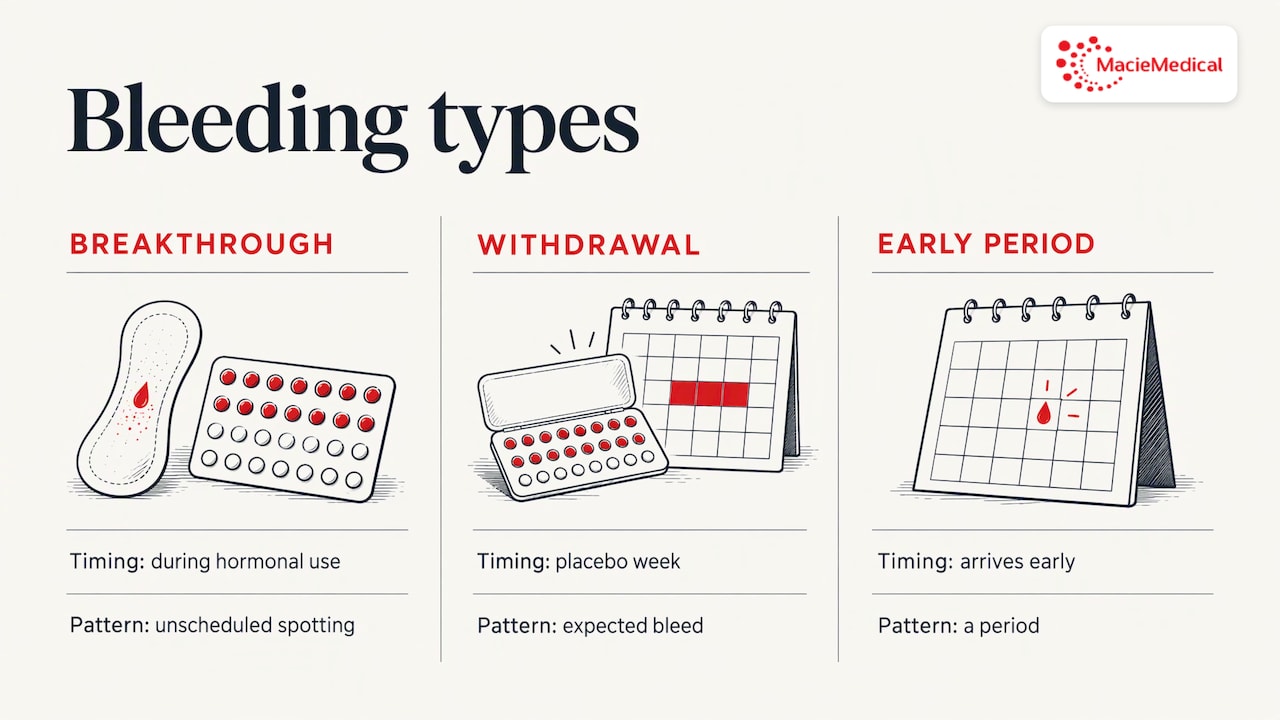
Breakthrough bleeding is unscheduled bleeding or spotting that happens while you are using a hormonal method. It can be a few drops of pink or brown discharge on a liner or enough that you reach for a pad. You may also hear it called spotting, irregular bleeding, or bleeding between periods on the pill.
It is different from the withdrawal bleed you get during the placebo week of a pill pack, which is expected. It is also different from a period that simply arrives early. The pattern matters: when it happens, how heavy it is, and how long it lasts. A small note on your phone calendar for two or three cycles gives a clinician far more to work with than “it happens sometimes.”
How common is it? A clinical review of combined hormonal contraception from the CDC notes that spotting or bleeding is common during the first 3 to 6 months of extended or continuous combined regimens and generally decreases with continued use. For progestin-only pills the pattern can be less predictable. That is why method choice and patience both matter.
Why it happens
Hormonal birth control holds your hormone levels steady, so the uterine lining behaves differently from a natural cycle. Sometimes the lining sheds a little at an unexpected time. ACOG lists several common contributors:
- Low-dose or ultra-low-dose pills. Breakthrough bleeding is more frequent with lower estrogen doses, as well as with implants and hormonal IUDs.
- Continuous or extended use. Skipping the placebo week means fewer scheduled bleeds, but more chances for unscheduled spotting early on.
- Inconsistent pill-taking. Taking a pill several hours late, or missing one, can let hormone levels dip enough to trigger spotting.
- Smoking. It is listed among factors that raise the chance of bleeding on the pill.
- Emergency contraception. Spotting can follow it.
- Infections. Chlamydia and gonorrhea can cause bleeding between periods.
- Conditions unrelated to birth control. Fibroids, for example, can cause bleeding of their own.
The CDC’s guidance for clinicians adds that evaluation should consider pregnancy, infection, medication interactions, thyroid disease and uterine causes when indicated. That list is why a quick “it’s probably just the pill” is not always the full answer, and why a conversation with a clinician is useful when the pattern is stubborn.
How long breakthrough bleeding usually lasts
The honest answer depends on the method.
| Method | What to expect |
|---|---|
| Combined pill, patch or ring (cycling) | Spotting is most common in the first few months and tends to ease with consistent use |
| Extended or continuous combined regimens | Common during the first 3 to 6 months, generally decreasing over time |
| Hormonal IUD | Often improves within 2 to 6 months after placement |
| Implant | The first three months’ bleeding pattern often predicts the later pattern |
| Progestin-only pill | Irregular bleeding is frequent and can be less predictable |
The IUD and implant timelines come from ACOG’s overview of breakthrough bleeding, and the extended-regimen timeline from the CDC. Those ranges are averages. Your own pattern is what counts, and a three-month check-in is a sensible moment to decide whether the method fits your life.
What you can do at home
Some steps are simple and worth trying before anything else.
- Take your pill at the same time every day. Set a phone alarm or tie it to a habit like brushing your teeth. Consistency is one of the most common fixes for pill-related spotting.
- Know your missed-pill instructions. The pack insert explains what to do after a late or missed dose and when to use backup protection. If you are unsure, ask us rather than guess.
- Stop smoking if you smoke. ACOG names smoking as a factor that can contribute to bleeding, and quitting helps your overall health too.
- Give it time, with a plan. Many people are advised to allow a few months for the body to adjust, as long as the bleeding is light and you feel well.
- Track it. Note the dates, the amount, any pain, and any missed pills. Bring the notes to your appointment.
Should you take a pregnancy test?
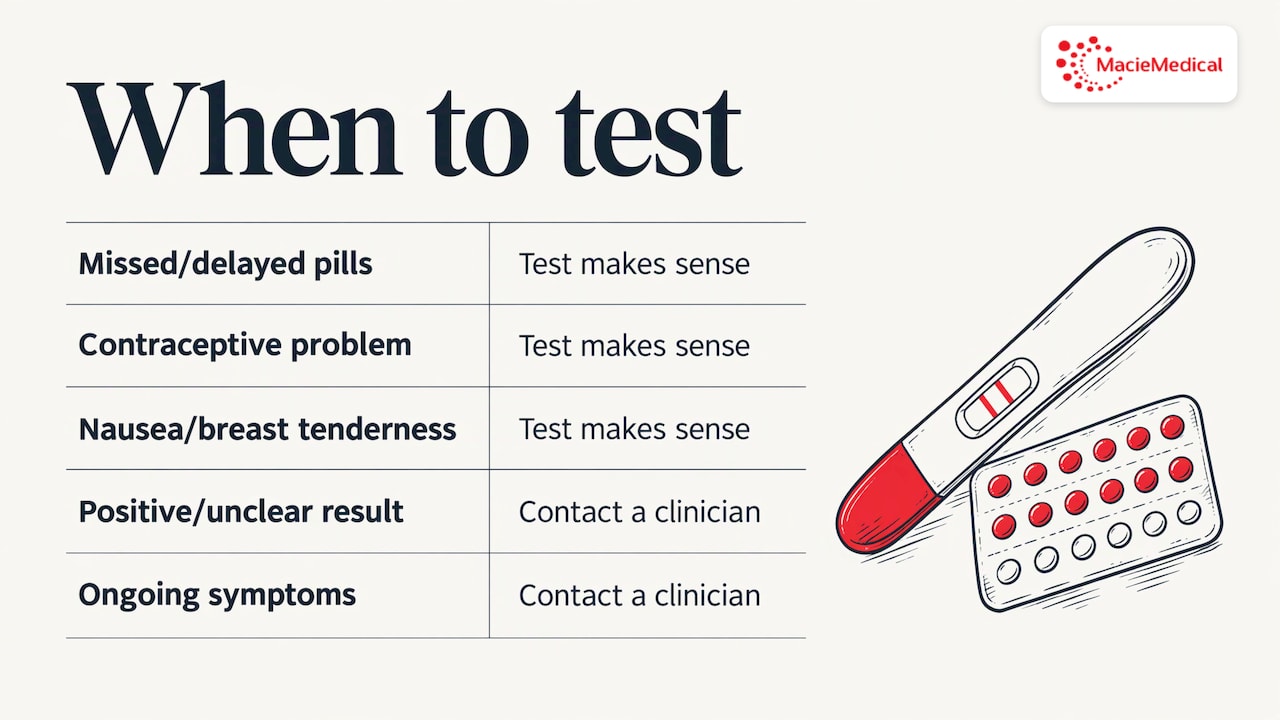
Spotting cannot confirm or rule out pregnancy. The CDC lists pregnancy among the possible underlying causes of unexpected bleeding on combined hormonal contraception, so a test makes sense if you missed or delayed pills, had a contraceptive problem, or have symptoms such as nausea or breast tenderness. Follow the test’s instructions, and contact a clinician if the result is positive, unclear, or your symptoms continue. If you are wondering how light spotting early in a pregnancy differs from a period, this guide to implantation bleeding versus a period explains when to test.
Medical options a clinician may discuss
If bleeding is bothersome and the basics have not helped, there are options. The right one depends on your method, your health history and what you want from your birth control. The clinical guidance is consistent on one point: the cause is evaluated first, and treatment is then matched to the method.
- Adjusting the pill. ACOG says clinicians may consider changing the estrogen dose or the placebo days in a pill pack for selected patients after evaluating the cause.
- Planned hormone-free days. For continuous combined regimens, the CDC says a hormone-free interval of 3 to 4 consecutive days may be considered. It is not advised during the first 21 days of use or more than once a month, because effectiveness may be reduced. This is a decision to make with a clinician, not on your own.
- NSAIDs. The CDC’s selected practice recommendations list NSAIDs for 5 to 7 days as an option for bleeding with a copper IUD, an implant or the DMPA injection. The American Academy of Family Physicians describes NSAIDs first for bleeding with a levonorgestrel IUD, and combined pills or NSAIDs for DMPA or implant users. NSAIDs are not right for everyone, so check with a clinician first.
- Short-term estrogen. ACOG notes this can be considered for selected patients.
- Changing methods. The CDC says you may continue or stop a method according to your own goals. If you decide to stop an IUD or implant, a provider removes it, talks through alternatives, and starts another method if you want one.
The AAFP also stresses that abnormal bleeding is common and bothersome enough that many people stop a method because of it. That is why counseling before you start, and a follow-up soon after, are part of good contraceptive care.
When to get checked
Most spotting is harmless, but certain patterns call for an evaluation. Based on the CDC’s guidance, arrange a visit if bleeding:
- is heavy,
- lasts more than seven consecutive days,
- continues beyond the expected adjustment period,
- happens after sex,
- comes with pain or possible infection exposure, or
- begins after missed doses or a possible pregnancy.
Go to an emergency department or call 911 if bleeding is very heavy or you feel faint, dizzy or short of breath, or if you have severe one-sided pelvic pain with a positive pregnancy test. Those symptoms should not wait for an appointment.
A clinician will usually ask about your pill-taking, your cycle pattern, your sexual history and any new medications, then may suggest a pregnancy test, infection testing, a pelvic exam, or blood work and imaging if something else seems likely. ACOG describes the process as discussing your symptoms, considering an exam and looking at other causes when needed. You can start that conversation with our contraception appointment guide, which explains what to expect and how to prepare.
Birth control and mood changes
Many people searching about spotting also ask about mood swings, and the question is fair. Here is what the evidence supports.
The CDC lists both spotting between periods and mood swings among possible side effects of hormonal birth control. At the same time, ACOG’s evidence summary says the data do not show that hormonal birth control routinely causes mood changes, while recognizing that patient-reported side effects are real and that method choice should be individualized. Both can be true: mood shifts are not inevitable, and if you notice them, they deserve to be taken seriously.
A few practical points:
- Timing is a clue. A review of hormonal contraception and mood disorders advises clinicians to look at the timing between starting a method and any new or worsened low mood. Write down when you started and when the changes began.
- Existing depression or bipolar disorder. A CDC systematic review found limited evidence that oral contraceptives, levonorgestrel IUDs or DMPA worsen the clinical course of depressive or bipolar disorders compared with no hormonal method. Still, tell your clinician about your history so the choice fits you.
- Seek help early. The CDC says talking with a healthcare provider is an appropriate first step if you think you may be depressed. If you ever have thoughts of harming yourself, call or text 988, the Suicide and Crisis Lifeline, or go to the nearest emergency room.
If your mood and your bleeding both feel off, mention both. Sometimes a different formulation or method addresses what is bothering you. Our team can talk that through in a visit, in person or by telehealth.
Our perspective
Breakthrough bleeding is rarely dangerous, but it is rarely trivial to the person living with it. It interrupts plans, raises worries about pregnancy and leads many women to quit a method that might have worked well with a small adjustment.
We start with a simple question: what do you want? Some patients want reassurance that the pattern is normal. Others want treatment, a different method, or a break from hormones. All of those are reasonable, and your plan should fit your life, not the other way around.
Our physician-led approach to women’s health, from well-woman exams and birth control to menopause care, is built around time and attention. We want every patient to leave understanding what is happening, what we will check, and what comes next. If you have been told to “just wait it out” without a plan, you deserve a clearer path.
Macie Medical
Seeing us for birth control concerns
Macie Medical is a primary care practice in Katy, led by Dr. Judith Aniekwena, MD, a board-certified physician in internal medicine and obesity medicine. Our women’s health services include well-woman exams, Pap smears, birth control and menopause care, and we offer same-day sick visits when something cannot wait. We serve patients from Katy, Cypress, Richmond and Memorial City, and telehealth visits are available to patients anywhere in Texas.
If you are due for a check-up, a well-woman exam in Katy is a natural time to review your birth control. You can also see everything we offer on our services page, or book online when you are ready.
What to bring to your appointment
A little preparation makes the visit more useful.
- The name of your birth control and the date you started or last changed it.
- A record of bleeding days, how heavy it was, and any pain.
- A list of missed or late pills, and any emergency contraception you used.
- All medications and supplements you take, since some can interact with hormonal contraception.
- Your questions about mood, weight, libido or any other changes you have noticed.
- Your goals: reassurance, treatment, a new method, or planning for pregnancy.
If you also have symptoms such as irregular cycles, hot flashes or sleep changes, say so. Our guide to hormonal imbalance in women covers other patterns worth discussing.
FAQ
Is spotting on birth control normal?
Yes. Light spotting is common, especially in the first few months of a new method or after switching. ACOG says it rarely signals a health problem. If it is heavy, lasts longer than a week or does not settle, have it checked.
Does breakthrough bleeding mean my birth control is not working?
No. ACOG states breakthrough bleeding does not mean your birth control is ineffective at preventing pregnancy. If you missed pills or had a contraceptive problem, however, take a pregnancy test and use backup protection as your pack instructs.
How do I stop breakthrough bleeding on birth control?
Start with taking your pill at the same time daily and, if you smoke, quitting. If bleeding continues, a clinician can look for other causes and may suggest changing the pill formulation, using NSAIDs for a short time, or switching methods. Do not change how you take a continuous regimen without guidance.
Can birth control cause mood swings?
Mood swings appear on the CDC’s list of possible side effects, while ACOG says the data do not show routine mood changes. Your experience still counts. Note when the changes started and talk with your clinician about whether another option suits you better.
When is bleeding between periods an emergency?
Go to the emergency room if bleeding is very heavy, you feel faint or dizzy, or you have severe pelvic pain, especially with a positive pregnancy test. For lighter bleeding that lasts more than seven days or follows sex, book a prompt visit.
Sources
- What You Should Know About Breakthrough Bleeding With Birth Control, ACOG
- Combined Hormonal Contraceptives, CDC
- Appendix E: Management of Bleeding Irregularities While Using Contraception, CDC
- Abnormal Uterine Bleeding Associated With Hormonal Contraception, American Family Physician
- Facts Are Important: Hormonal Birth Control, ACOG
- Diabetes and Hormonal Birth Control, CDC
- Safety of hormonal contraception and intrauterine devices among women with depressive and bipolar disorders, CDC
- Hormonal contraception and mood disorders
- Implantation Bleeding vs Period: When to Test